
Graham's Law of Effusion Concepts

Interactive Video
•
Chemistry
•
9th - 10th Grade
•
Practice Problem
•
Hard

Patricia Brown
FREE Resource
Read more
10 questions
Show all answers
1.
MULTIPLE CHOICE QUESTION
30 sec • 1 pt
What does Graham's Law of Effusion state about the relationship between effusion rate and molecular mass?
Effusion rate is directly proportional to molecular mass.
Effusion rate is inversely proportional to the square of molecular mass.
Effusion rate is directly proportional to the square root of molecular mass.
Effusion rate is inversely proportional to the square root of molecular mass.
2.
MULTIPLE CHOICE QUESTION
30 sec • 1 pt
In the example comparing hydrogen and carbon dioxide, how many times faster does hydrogen effuse?
3.21 times faster
4.69 times faster
5.00 times faster
2.34 times faster
3.
MULTIPLE CHOICE QUESTION
30 sec • 1 pt
What is the molecular mass of hydrogen used in the effusion rate calculation?
1
4
2
16
4.
MULTIPLE CHOICE QUESTION
30 sec • 1 pt
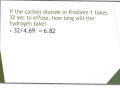
If carbon dioxide takes 32 seconds to effuse, how long does it take for hydrogen to effuse?
10.5 seconds
8.2 seconds
6.82 seconds
4.69 seconds
5.
MULTIPLE CHOICE QUESTION
30 sec • 1 pt
What additional information is needed to calculate the effusion time for hydrogen?
Pressure
Volume
Temperature
Effusion rate of hydrogen
6.
MULTIPLE CHOICE QUESTION
30 sec • 1 pt
In the example with an unknown gas and helium, what is the effusion rate of the unknown gas compared to helium?
0.50 times as fast
0.75 times as fast
0.25 times as fast
1.00 times as fast
7.
MULTIPLE CHOICE QUESTION
30 sec • 1 pt
What is the molecular mass of helium used in the unknown gas calculation?
16
8
4
2
Access all questions and much more by creating a free account
Create resources
Host any resource
Get auto-graded reports

Continue with Google

Continue with Email

Continue with Classlink

Continue with Clever
or continue with

Microsoft
%20(1).png)
Apple

Others
Already have an account?

