
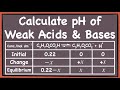
ICE Table and pH Calculations

Interactive Video
•
Chemistry
•
11th - 12th Grade
•
Practice Problem
•
Hard

Patricia Brown
FREE Resource
Read more
10 questions
Show all answers
1.
MULTIPLE CHOICE QUESTION
30 sec • 1 pt
What does the 'I' in the ICE table stand for?
Inert substance
Intermediate state
Ionization constant
Initial concentration
2.
MULTIPLE CHOICE QUESTION
30 sec • 1 pt
Why do we use the ICE table for weak acids and bases?
They fully ionize in water
They do not ionize at all
They only partially ionize in water
They are strong electrolytes
3.
MULTIPLE CHOICE QUESTION
30 sec • 1 pt
In the ICE table for citric acid, what is the initial concentration of the dissociated ions?
1 mole per dm³
0 mole per dm³
0.1 mole per dm³
0.22 mole per dm³
4.
MULTIPLE CHOICE QUESTION
30 sec • 1 pt
What assumption is made about 'x' when calculating the pH of a weak acid like citric acid?
x is large compared to initial concentration
x is twice the initial concentration
x is negligible compared to initial concentration
x is equal to the initial concentration
5.
MULTIPLE CHOICE QUESTION
30 sec • 1 pt
What is the pH of citric acid when the concentration of hydrogen ions is 0.012759 mole per dm³?
7.00
14.00
1.89
3.00
6.
MULTIPLE CHOICE QUESTION
30 sec • 1 pt
What is the initial concentration of ammonia in the ICE table example?
0.22 mole per dm³
0.100 mole per dm³
1.00 mole per dm³
0.012 mole per dm³
7.
MULTIPLE CHOICE QUESTION
30 sec • 1 pt
Why is water not included in the ICE table for ammonia?
It is a strong base
It does not participate in the reaction
It is a strong acid
It is already ionized
Access all questions and much more by creating a free account
Create resources
Host any resource
Get auto-graded reports

Continue with Google

Continue with Email

Continue with Classlink

Continue with Clever
or continue with

Microsoft
%20(1).png)
Apple

Others
Already have an account?


