
Asymptotes and Discontinuities in Functions

Interactive Video
•
Mathematics
•
9th - 10th Grade
•
Practice Problem
•
Hard

Patricia Brown
FREE Resource
Read more
10 questions
Show all answers
1.
MULTIPLE CHOICE QUESTION
30 sec • 1 pt
What is the vertical asymptote of the function f(x) = 2x / (x - 3)?
x = 2
x = -3
x = 3
x = 0
2.
MULTIPLE CHOICE QUESTION
30 sec • 1 pt
For the function f(x) = 2x / (x - 3), what is the horizontal asymptote?
y = 3
y = 0
y = 1
y = 2
3.
MULTIPLE CHOICE QUESTION
30 sec • 1 pt
In the function g(x) = (x - 4) / x^2, what is the vertical asymptote?
x = 4
x = 0
x = 2
x = -4
4.
MULTIPLE CHOICE QUESTION
30 sec • 1 pt
What is the horizontal asymptote for the function g(x) = (x - 4) / x^2?
y = 1
y = 0
y = 2
y = -1
5.
MULTIPLE CHOICE QUESTION
30 sec • 1 pt
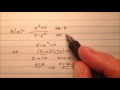
For the function h(x) = (x^2 + 4) / (4 - x^2), what are the vertical asymptotes?
x = 2 and x = -2
x = 3 and x = -3
x = 1 and x = -1
x = 0 and x = 4
6.
MULTIPLE CHOICE QUESTION
30 sec • 1 pt
What is the horizontal asymptote of the function h(x) = (x^2 + 4) / (4 - x^2)?
y = 2
y = 1
y = 0
y = -1
7.
MULTIPLE CHOICE QUESTION
30 sec • 1 pt
In the function f(x) = (x^3 + 2) / (x - 1), why is there no horizontal asymptote?
The degree of the numerator is less than the denominator.
The degree of the numerator is equal to the denominator.
The degree of the numerator is greater than the denominator.
The function is not a rational function.
Access all questions and much more by creating a free account
Create resources
Host any resource
Get auto-graded reports

Continue with Google

Continue with Email

Continue with Classlink

Continue with Clever
or continue with

Microsoft
%20(1).png)
Apple

Others
Already have an account?

