
Frequency Graphs and Data Representation

Interactive Video
•
Biology
•
9th - 10th Grade
•
Practice Problem
•
Hard

Patricia Brown
FREE Resource
Read more
10 questions
Show all answers
1.
MULTIPLE CHOICE QUESTION
30 sec • 1 pt
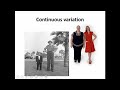
What is an example of continuous variation?
Shoe size
Eye color
Height
Tongue rolling
2.
MULTIPLE CHOICE QUESTION
30 sec • 1 pt
Which of the following is a characteristic of discontinuous variation?
Affected by environmental factors
Grouped into distinct categories
Usually caused by multiple genes
Can take any numerical value
3.
MULTIPLE CHOICE QUESTION
30 sec • 1 pt
Which of the following is NOT a cause of continuous variation?
Multiple genes working together
Single gene influence
Environmental factors
Combination of genes and environment
4.
MULTIPLE CHOICE QUESTION
30 sec • 1 pt
What is a common method to represent discontinuous data?
Scatter plot
Pie chart
Bar chart
Line graph
5.
MULTIPLE CHOICE QUESTION
30 sec • 1 pt
What is the range in a set of continuous data?
The most frequently occurring value
The average of all values
The difference between the largest and smallest values
The sum of all values
6.
MULTIPLE CHOICE QUESTION
30 sec • 1 pt
How should data be categorized for a frequency graph?
By the most frequent value
Starting with the lowest and ending with the highest
By alphabetical order
Randomly
7.
MULTIPLE CHOICE QUESTION
30 sec • 1 pt
What is the first step in drawing a frequency graph?
Labeling the axes
Drawing the axes
Drawing the bars
Calculating the range
Access all questions and much more by creating a free account
Create resources
Host any resource
Get auto-graded reports

Continue with Google

Continue with Email

Continue with Classlink

Continue with Clever
or continue with

Microsoft
%20(1).png)
Apple

Others
Already have an account?

