
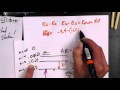
Energy Transitions and Photon Emission

Interactive Video
•
Physics
•
11th - 12th Grade
•
Practice Problem
•
Hard

Patricia Brown
FREE Resource
Read more
10 questions
Show all answers
1.
MULTIPLE CHOICE QUESTION
30 sec • 1 pt
What happens when an electron falls from a higher energy state to a lower one?
It gains mass.
It remains in the same state.
It releases energy.
It absorbs energy.
2.
MULTIPLE CHOICE QUESTION
30 sec • 1 pt
In the transition from n=3 to n=2, what is the initial energy state?
n=3
n=2
n=1
n=4
3.
MULTIPLE CHOICE QUESTION
30 sec • 1 pt
What is the formula for energy change in terms of photon energy?
E = hf
E = kT
E = mc^2
E = mv^2
4.
MULTIPLE CHOICE QUESTION
30 sec • 1 pt
Which constant is used in the formula HC/λ?
Gravitational constant
Boltzmann constant
Planck's constant
Coulomb's constant
5.
MULTIPLE CHOICE QUESTION
30 sec • 1 pt
What is the calculated wavelength when an electron transitions from n=3 to n=2?
700 nm
656 nm
500 nm
400 nm
6.
MULTIPLE CHOICE QUESTION
30 sec • 1 pt
Why can't wavelengths be negative?
Because they represent energy absorption.
Because they represent a physical distance.
Because they represent energy release.
Because they represent mass.
7.
MULTIPLE CHOICE QUESTION
30 sec • 1 pt
What does a negative sign in the wavelength calculation indicate?
Energy is released.
Energy is absorbed.
The electron gains mass.
The electron remains stationary.
Access all questions and much more by creating a free account
Create resources
Host any resource
Get auto-graded reports

Continue with Google

Continue with Email

Continue with Classlink

Continue with Clever
or continue with

Microsoft
%20(1).png)
Apple

Others
Already have an account?

