
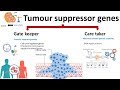
Tumor Suppressor Genes and Functions

Interactive Video
•
Biology
•
11th - 12th Grade
•
Practice Problem
•
Hard

Patricia Brown
FREE Resource
Read more
10 questions
Show all answers
1.
MULTIPLE CHOICE QUESTION
30 sec • 1 pt
What is the primary role of proto-oncogenes in cell biology?
To suppress cell growth
To promote cell division and growth
To repair DNA damage
To induce apoptosis
2.
MULTIPLE CHOICE QUESTION
30 sec • 1 pt
Which category of tumor suppressor genes is responsible for maintaining genetic stability?
Gatekeepers
Caretakers
Apoptotic genes
Proto-oncogenes
3.
MULTIPLE CHOICE QUESTION
30 sec • 1 pt
What is the function of pRB in the cell cycle?
To sequester E2F and prevent cell cycle progression
To promote the transition from G1 to S phase
To induce apoptosis
To repair DNA damage
4.
MULTIPLE CHOICE QUESTION
30 sec • 1 pt
Which protein is transcribed by p53 to halt the cell cycle?
Cyclin D
p21
Bax
E2F
5.
MULTIPLE CHOICE QUESTION
30 sec • 1 pt
What happens when pRB is non-functional?
Apoptosis is induced
DNA repair is enhanced
Growth and proliferation occur
Cell cycle progression is halted
6.
MULTIPLE CHOICE QUESTION
30 sec • 1 pt
What is the role of Bax in apoptosis?
To repair DNA damage
To create pores in the mitochondrial membrane
To promote cell division
To sequester E2F
7.
MULTIPLE CHOICE QUESTION
30 sec • 1 pt
Which family of proteins is involved in inhibiting the cyclin D-CDK4 complex?
E2F family
p53 family
CIP family
Bcl-2 family
Access all questions and much more by creating a free account
Create resources
Host any resource
Get auto-graded reports

Continue with Google

Continue with Email

Continue with Microsoft
or continue with

%20(1).png)
Apple

Others
By signing up, you agree to our Terms of Service & Privacy Policy
Already have an account?

