
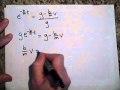
Velocity, Acceleration, and Air Resistance

Interactive Video
•
Physics
•
11th - 12th Grade
•
Practice Problem
•
Hard

Patricia Brown
FREE Resource
Read more
10 questions
Show all answers
1.
MULTIPLE CHOICE QUESTION
30 sec • 1 pt
What is the initial step in analyzing objects falling with air resistance?
Applying Newton's First Law
Using the concept of terminal velocity
Applying Newton's Second Law
Considering the effects of gravity only
2.
MULTIPLE CHOICE QUESTION
30 sec • 1 pt
What mathematical technique is used to derive the velocity equation?
Fourier transform
Differentiation
Matrix multiplication
Integration by substitution
3.
MULTIPLE CHOICE QUESTION
30 sec • 1 pt
What is the expression for terminal velocity in terms of mass (m), gravity (g), and drag coefficient (B)?
B/m
B/mg
mB/g
mg/B
4.
MULTIPLE CHOICE QUESTION
30 sec • 1 pt
How does the velocity of an object change over time when considering air resistance?
It approaches terminal velocity
It decreases exponentially
It increases linearly
It remains constant
5.
MULTIPLE CHOICE QUESTION
30 sec • 1 pt
What is the derivative of velocity with respect to time known as?
Jerk
Acceleration
Speed
Displacement
6.
MULTIPLE CHOICE QUESTION
30 sec • 1 pt
For low speeds, how is the force due to air resistance approximated?
Bv^2
Bv
Bv^3
B/v
7.
MULTIPLE CHOICE QUESTION
30 sec • 1 pt
What happens to the term involving e in the velocity equation as time increases?
It oscillates
It decays
It remains constant
It increases
Access all questions and much more by creating a free account
Create resources
Host any resource
Get auto-graded reports

Continue with Google

Continue with Email

Continue with Classlink

Continue with Clever
or continue with

Microsoft
%20(1).png)
Apple

Others
Already have an account?

