
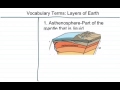
Earth's Layers and Note-Taking Strategies

Interactive Video
•
Science
•
6th - 7th Grade
•
Practice Problem
•
Hard

Patricia Brown
FREE Resource
Read more
10 questions
Show all answers
1.
MULTIPLE CHOICE QUESTION
30 sec • 1 pt
What is the primary method suggested for taking notes in this lesson?
Writing a detailed summary
Drawing pictures and creating original sentences
Answering advanced questions
Memorizing definitions
2.
MULTIPLE CHOICE QUESTION
30 sec • 1 pt
What is the state of the mantle as described in the lesson?
Completely solid
Gaseous
Completely liquid
Partially solid and partially liquid
3.
MULTIPLE CHOICE QUESTION
30 sec • 1 pt
Which part of the Earth's layers is described as being under great pressure and partially liquid?
Crust
Lithosphere
Asthenosphere
Core
4.
MULTIPLE CHOICE QUESTION
30 sec • 1 pt
What is the lithosphere primarily composed of?
Gaseous elements
Molten metal
Liquid magma
Solid and rigid rock
5.
MULTIPLE CHOICE QUESTION
30 sec • 1 pt
Where is the lithosphere located in relation to the crust?
Floating on the ocean
Below the crust
Above the crust
Within the core
6.
MULTIPLE CHOICE QUESTION
30 sec • 1 pt
What is the main difference between oceanic crust and continental crust?
Oceanic crust is thicker than continental crust
Oceanic crust is where the ocean sits, while continental crust is where the land sits
Oceanic crust is made of metal, while continental crust is made of rock
Oceanic crust is above the lithosphere, while continental crust is below it
7.
MULTIPLE CHOICE QUESTION
30 sec • 1 pt
Which type of crust is associated with landmasses?
Lithosphere
Asthenosphere
Continental crust
Oceanic crust
Access all questions and much more by creating a free account
Create resources
Host any resource
Get auto-graded reports

Continue with Google

Continue with Email

Continue with Classlink

Continue with Clever
or continue with

Microsoft
%20(1).png)
Apple

Others
Already have an account?


