
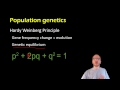
Hardy-Weinberg Equilibrium Concepts

Interactive Video
•
Biology
•
9th - 10th Grade
•
Practice Problem
•
Hard

Patricia Brown
FREE Resource
Read more
10 questions
Show all answers
1.
MULTIPLE CHOICE QUESTION
30 sec • 1 pt
What is necessary for evolution to occur?
An individual must change its genes.
A population's allele frequencies must change over time.
An individual must adapt to its environment.
A species must become extinct.
2.
MULTIPLE CHOICE QUESTION
30 sec • 1 pt
What does the Hardy-Weinberg principle assume about a population?
The population is increasing in size.
The population is decreasing in size.
The population is in genetic equilibrium.
The population is constantly evolving.
3.
MULTIPLE CHOICE QUESTION
30 sec • 1 pt
In the Hardy-Weinberg equation, what does 'p' represent?
The frequency of the dominant allele.
The frequency of the recessive allele.
The frequency of heterozygotes.
The total number of alleles.
4.
MULTIPLE CHOICE QUESTION
30 sec • 1 pt
How do you calculate the frequency of heterozygotes using the Hardy-Weinberg equation?
2pq
p plus q
q squared
p squared
5.
MULTIPLE CHOICE QUESTION
30 sec • 1 pt
If the frequency of a recessive phenotype is 0.09, what is the frequency of the recessive allele?
0.49
0.7
0.3
0.09
6.
MULTIPLE CHOICE QUESTION
30 sec • 1 pt
Which condition is NOT required for Hardy-Weinberg equilibrium?
Large population size
Random mating
High mutation rate
No migration
7.
MULTIPLE CHOICE QUESTION
30 sec • 1 pt
What effect does migration have on a population in Hardy-Weinberg equilibrium?
It stabilizes allele frequencies.
It introduces new alleles, disrupting equilibrium.
It decreases genetic diversity.
It increases the population size.
Access all questions and much more by creating a free account
Create resources
Host any resource
Get auto-graded reports

Continue with Google

Continue with Email

Continue with Classlink

Continue with Clever
or continue with

Microsoft
%20(1).png)
Apple

Others
Already have an account?

