
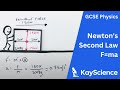
Newton's Laws and Force Calculations

Interactive Video
•
Physics
•
9th - 10th Grade
•
Practice Problem
•
Hard

Patricia Brown
FREE Resource
Read more
10 questions
Show all answers
1.
MULTIPLE CHOICE QUESTION
30 sec • 1 pt
What is the relationship between force and acceleration according to the introduction?
Force is inversely proportional to acceleration.
Force is directly proportional to acceleration.
Force is unrelated to acceleration.
Force is equal to acceleration.
2.
MULTIPLE CHOICE QUESTION
30 sec • 1 pt
If a box has a weight of 1960 Newtons acting downwards, what is the normal contact force acting upwards?
980 Newtons
1960 Newtons
3920 Newtons
0 Newtons
3.
MULTIPLE CHOICE QUESTION
30 sec • 1 pt
How do you calculate the resultant force acting on the box when a person pushes it with 200 Newtons and friction is 50 Newtons?
Divide the push force by the friction.
Add the forces together.
Subtract the friction from the push force.
Multiply the forces.
4.
MULTIPLE CHOICE QUESTION
30 sec • 1 pt
What is the acceleration of a 200 kg box when the resultant force is 150 Newtons?
0.75 m/s²
1.5 m/s²
2 m/s²
0.5 m/s²
5.
MULTIPLE CHOICE QUESTION
30 sec • 1 pt
When the push force on the box is increased to 350 Newtons, what is the new resultant force if friction remains 50 Newtons?
400 Newtons
300 Newtons
250 Newtons
350 Newtons
6.
MULTIPLE CHOICE QUESTION
30 sec • 1 pt
What happens to the acceleration of the box when the resultant force is doubled?
It triples.
It doubles.
It remains the same.
It halves.
7.
MULTIPLE CHOICE QUESTION
30 sec • 1 pt
For two cars with masses of 1000 kg and 500 kg, what is the acceleration of the smaller car if both experience a force of 2000 Newtons?
2 m/s²
4 m/s²
1 m/s²
3 m/s²
Access all questions and much more by creating a free account
Create resources
Host any resource
Get auto-graded reports

Continue with Google

Continue with Email

Continue with Classlink

Continue with Clever
or continue with

Microsoft
%20(1).png)
Apple

Others
Already have an account?


