
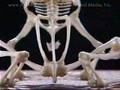
Frog Anatomy and Jumping Mechanics

Interactive Video
•
Biology
•
9th - 10th Grade
•
Practice Problem
•
Hard

Patricia Brown
FREE Resource
Read more
10 questions
Show all answers
1.
MULTIPLE CHOICE QUESTION
30 sec • 1 pt
Why are frogs particularly suited for studying skeletal evolution?
They have a unique and interesting skeleton.
They have the largest number of vertebrae among vertebrates.
Their skeletons are identical to those of reptiles.
They have a very heavy skeleton.
2.
MULTIPLE CHOICE QUESTION
30 sec • 1 pt
How many vertebrae do frogs typically have?
About 20
About 15
About 8
About 30
3.
MULTIPLE CHOICE QUESTION
30 sec • 1 pt
What is the primary function of the fused vertebrae in frogs?
To protect the frog's internal organs
To support the frog's large brain
To make the frog's back more flexible
To increase the frog's jumping force
4.
MULTIPLE CHOICE QUESTION
30 sec • 1 pt
Why is the head of a frog relatively light?
To help with camouflage
To allow for better swimming
To make jumping easier
To support a larger brain
5.
MULTIPLE CHOICE QUESTION
30 sec • 1 pt
What is the urostyle in a frog's skeleton?
A bone in the frog's head
A long bone inside the frog acting like a tail
A muscle in the frog's leg
A part of the frog's foot
6.
MULTIPLE CHOICE QUESTION
30 sec • 1 pt
How does the urostyle function in a frog's body?
It protects the frog's heart.
It supports the frog's digestive system.
It acts as a counterbalance for jumping.
It helps the frog to swim faster.
7.
MULTIPLE CHOICE QUESTION
30 sec • 1 pt
What additional feature do frogs have in their lower limbs?
An extra segment in their lower limb
A retractable claw
A webbed foot
A detachable tail
Access all questions and much more by creating a free account
Create resources
Host any resource
Get auto-graded reports

Continue with Google

Continue with Email

Continue with Classlink

Continue with Clever
or continue with

Microsoft
%20(1).png)
Apple

Others
Already have an account?

