
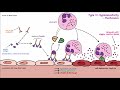
Immune Complexes and Hypersensitivity

Interactive Video
•
Biology
•
11th - 12th Grade
•
Practice Problem
•
Hard

Patricia Brown
FREE Resource
Read more
10 questions
Show all answers
1.
MULTIPLE CHOICE QUESTION
30 sec • 1 pt
What triggers a type 3 hypersensitivity reaction?
Binding of antibodies to soluble antigens
Direct attack by T-cells
Binding of antibodies to cell surface antigens
Activation of mast cells
2.
MULTIPLE CHOICE QUESTION
30 sec • 1 pt
What is the role of C5a in the complement cascade?
It inhibits the complement cascade
It serves as a chemotactic factor for neutrophils
It forms the membrane attack complex
It acts as an opsonin
3.
MULTIPLE CHOICE QUESTION
30 sec • 1 pt
Which of the following is NOT a site where immune complexes can attach?
Synovium of joints
Glomeruli of kidneys
Epithelial lining of alveoli
Nerve endings
4.
MULTIPLE CHOICE QUESTION
30 sec • 1 pt
Which of the following is an example of a localized type 3 hypersensitivity reaction?
Systemic lupus erythematosus
Serum sickness
Farmer's lung
Rheumatoid arthritis
5.
MULTIPLE CHOICE QUESTION
30 sec • 1 pt
What is the result of immune complexes forming at the site of a tetanus vaccination?
Systemic inflammation
Localized inflammation and induration
Delayed-type hypersensitivity reaction
Immediate hypersensitivity reaction
6.
MULTIPLE CHOICE QUESTION
30 sec • 1 pt
What condition is associated with cryoglobulins precipitating in circulation?
Serum sickness
Arthus reaction
Raynaud's phenomenon
Celiac disease
7.
MULTIPLE CHOICE QUESTION
30 sec • 1 pt
What is a common symptom of systemic type 3 hypersensitivity reactions?
Shortness of breath
Pallor and numbness
Joint pain
Localized rash
Access all questions and much more by creating a free account
Create resources
Host any resource
Get auto-graded reports

Continue with Google

Continue with Email

Continue with Classlink

Continue with Clever
or continue with

Microsoft
%20(1).png)
Apple

Others
Already have an account?

