
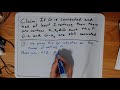
Induction Proofs in Graph Theory

Interactive Video
•
Mathematics
•
9th - 10th Grade
•
Practice Problem
•
Hard

Patricia Brown
FREE Resource
Read more
10 questions
Show all answers
1.
MULTIPLE CHOICE QUESTION
30 sec • 1 pt
What is the main claim discussed in the induction proof for graph theory?
A graph with two vertices is always disconnected.
A connected graph with at least two vertices can have two vertices removed and still remain connected.
A graph with more than three vertices is always connected.
A disconnected graph can be made connected by adding one vertex.
2.
MULTIPLE CHOICE QUESTION
30 sec • 1 pt
In the example with four vertices, which vertices can be removed to keep the graph connected?
The two end vertices
The first and third vertices
Any two vertices
The two middle vertices
3.
MULTIPLE CHOICE QUESTION
30 sec • 1 pt
What is the base case for the induction proof in graph theory?
A graph with two vertices
A graph with three vertices
A graph with one vertex
A graph with no vertices
4.
MULTIPLE CHOICE QUESTION
30 sec • 1 pt
What type of induction is used in the proof?
Strong induction
Direct induction
Mathematical induction
Weak induction
5.
MULTIPLE CHOICE QUESTION
30 sec • 1 pt
In the inductive step, what is assumed about graphs with fewer vertices?
They are always complete graphs.
They are always disconnected.
The claim holds true for them.
They have no edges.
6.
MULTIPLE CHOICE QUESTION
30 sec • 1 pt
What happens in Case 1 of the inductive step?
The graph becomes a cycle.
Removing any vertex keeps the graph connected.
The graph becomes a tree.
Removing any vertex disconnects the graph.
7.
MULTIPLE CHOICE QUESTION
30 sec • 1 pt
In Case 2 of the inductive step, what is the significance of vertex v?
It has no edges.
It is the only vertex that can be removed.
Removing it disconnects the graph.
It is the center of the graph.
Access all questions and much more by creating a free account
Create resources
Host any resource
Get auto-graded reports

Continue with Google

Continue with Email

Continue with Microsoft
or continue with

%20(1).png)
Apple

Others
By signing up, you agree to our Terms of Service & Privacy Policy
Already have an account?

