
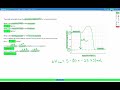
Enthalpy Changes and Reaction Types

Interactive Video
•
Chemistry
•
9th - 10th Grade
•
Practice Problem
•
Hard

Patricia Brown
FREE Resource
Read more
10 questions
Show all answers
1.
MULTIPLE CHOICE QUESTION
30 sec • 1 pt
What does the y-axis represent in the potential energy profile graph?
Temperature in Celsius
Time in seconds
Potential energy in kilojoules per mole
Reaction progress
2.
MULTIPLE CHOICE QUESTION
30 sec • 1 pt
How do you determine the potential energy of reactants from the graph?
By finding the midpoint of the graph
By calculating the slope of the graph
By reading the y-axis at the reactants
By measuring the x-axis at the start
3.
MULTIPLE CHOICE QUESTION
30 sec • 1 pt
What is the enthalpy change for a forward reaction if the reactants have 30 KJ/mol and the products have 5 KJ/mol?
-25 KJ/mol
25 KJ/mol
-5 KJ/mol
5 KJ/mol
4.
MULTIPLE CHOICE QUESTION
30 sec • 1 pt
What does a negative enthalpy change indicate about a reaction?
The reaction is at equilibrium
Energy is absorbed
Energy is released
The reaction is endothermic
5.
MULTIPLE CHOICE QUESTION
30 sec • 1 pt
If a reaction releases energy, what type of reaction is it?
Adiabatic
Endothermic
Isothermal
Exothermic
6.
MULTIPLE CHOICE QUESTION
30 sec • 1 pt
In the backward reaction example, what is the potential energy of the reactants?
30 KJ/mol
40 KJ/mol
50 KJ/mol
20 KJ/mol
7.
MULTIPLE CHOICE QUESTION
30 sec • 1 pt
How is the enthalpy change calculated for a backward reaction?
Divide initial energy by final energy
Add initial and final energies
Multiply initial energy by final energy
Subtract initial energy from final energy
Access all questions and much more by creating a free account
Create resources
Host any resource
Get auto-graded reports

Continue with Google

Continue with Email

Continue with Classlink

Continue with Clever
or continue with

Microsoft
%20(1).png)
Apple

Others
Already have an account?
Similar Resources on Wayground

8 questions
7 enigmas de la ciencia
Interactive video
•
10th - 12th Grade
6 questions
Exploring Earth, Sun, and Moon: the Sun
Interactive video
•
10th - 12th Grade
6 questions
CLEAN : Nice businesses worried about holiday results after attack
Interactive video
•
9th - 10th Grade
6 questions
SKorean president meets Japanese PM
Interactive video
•
9th - 10th Grade
6 questions
CLEAN: Israel PM declares victory in primary vote
Interactive video
•
9th - 12th Grade
2 questions
VOICED : Angela Merkel autor de matanza podria ser demandante de asilo
Interactive video
•
9th - 10th Grade
Popular Resources on Wayground
7 questions
History of Valentine's Day
Interactive video
•
4th Grade
15 questions
Fractions on a Number Line

Quiz
•
3rd Grade
20 questions
Equivalent Fractions
Quiz
•
3rd Grade
25 questions
Multiplication Facts
Quiz
•
5th Grade
22 questions
fractions
Quiz
•
3rd Grade
15 questions
Valentine's Day Trivia
Quiz
•
3rd Grade
20 questions
Main Idea and Details
Quiz
•
5th Grade
20 questions
Context Clues
Quiz
•
6th Grade
Discover more resources for Chemistry
25 questions
Unit 8 Stoichiometry Review
Quiz
•
10th Grade
20 questions
Types of Chemical Reactions
Quiz
•
9th - 12th Grade
19 questions
Stoichiometry, Limiting Reactants, and Percent Yield
Quiz
•
10th Grade
10 questions
Formative 3BD: Ionic Bonds
Quiz
•
9th Grade
15 questions
Balancing Chemical Equations
Quiz
•
10th - 12th Grade
20 questions
Naming & Writing Chemical Formulas
Quiz
•
10th Grade
10 questions
Identifying types of reactions
Quiz
•
9th - 12th Grade
20 questions
Periodic Trends
Quiz
•
10th Grade