
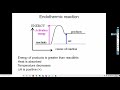
Chemical Reactions and Energy Changes

Interactive Video
•
Chemistry
•
9th - 10th Grade
•
Practice Problem
•
Hard

Patricia Brown
Used 1+ times
FREE Resource
Read more
10 questions
Show all answers
1.
MULTIPLE CHOICE QUESTION
30 sec • 1 pt
What does a potential energy diagram illustrate in a chemical reaction?
The physical state of products
The speed of the reaction
The color change of reactants
The energy changes during the reaction
2.
MULTIPLE CHOICE QUESTION
30 sec • 1 pt
What is the role of activation energy in a chemical reaction?
It is the energy that cools down the reaction
It is the energy released at the end of a reaction
It is the energy required to start a reaction
It determines the color of the products
3.
MULTIPLE CHOICE QUESTION
30 sec • 1 pt
How can you determine if a reaction is exothermic or endothermic from a potential energy diagram?
By observing the physical state of the reactants
By measuring the time taken for the reaction
By comparing the energy levels of reactants and products
By checking the color of the diagram
4.
MULTIPLE CHOICE QUESTION
30 sec • 1 pt
In an exothermic reaction, what happens to the temperature of the surroundings?
It fluctuates randomly
It decreases
It remains constant
It increases
5.
MULTIPLE CHOICE QUESTION
30 sec • 1 pt
What is the significance of delta H in a chemical reaction?
It determines the physical state of products
It indicates the speed of the reaction
It shows the change in heat energy
It measures the color change
6.
MULTIPLE CHOICE QUESTION
30 sec • 1 pt
Why do elements not have a heat of formation?
Because they are always in gaseous state
Because they do not participate in reactions
Because they have no energy
Because they are not formed but exist naturally
7.
MULTIPLE CHOICE QUESTION
30 sec • 1 pt
In the given example, what is the heat of formation for oxygen?
Zero
75.8 kJ/mol
Negative 285.8 kJ/mol
Negative 393.2 kJ/mol
Access all questions and much more by creating a free account
Create resources
Host any resource
Get auto-graded reports

Continue with Google

Continue with Email

Continue with Classlink

Continue with Clever
or continue with

Microsoft
%20(1).png)
Apple

Others
Already have an account?

