
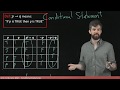
Logical Equivalence and Conditional Statements

Interactive Video
•
Mathematics
•
9th - 10th Grade
•
Practice Problem
•
Hard

Thomas White
FREE Resource
Read more
10 questions
Show all answers
1.
MULTIPLE CHOICE QUESTION
30 sec • 1 pt
What is the basic form of a conditional statement?
P or Q
P and Q
If P then Q
If Q then P
2.
MULTIPLE CHOICE QUESTION
30 sec • 1 pt
What is the first step in constructing a truth table for a conditional statement?
Determine the conclusion
Identify the hypothesis
Analyze the scenarios
Fill in the variables
3.
MULTIPLE CHOICE QUESTION
30 sec • 1 pt
In a truth table, when is a conditional statement considered vacuously true?
When both P and Q are true
When P is false
When Q is false
When both P and Q are false
4.
MULTIPLE CHOICE QUESTION
30 sec • 1 pt
In the context of logical statements, what does 'vacuously true' mean?
The conclusion is false
Both hypothesis and conclusion are true
The hypothesis is true
The hypothesis is false
5.
MULTIPLE CHOICE QUESTION
30 sec • 1 pt
What does the column 'not P or Q' represent in a truth table?
The logical equivalence of P implies Q
The conjunction of P and Q
The disjunction of P and Q
The negation of Q
6.
MULTIPLE CHOICE QUESTION
30 sec • 1 pt
What is the logical equivalence of 'P implies Q'?
Not P or Q
P and Q
Not P and Q
P or not Q
7.
MULTIPLE CHOICE QUESTION
30 sec • 1 pt
What does the 'or' statement in 'not P or Q' signify?
At least one condition must be true
Both conditions must be true
Neither condition can be true
Both conditions must be false
Access all questions and much more by creating a free account
Create resources
Host any resource
Get auto-graded reports

Continue with Google

Continue with Email

Continue with Microsoft
or continue with

%20(1).png)
Apple

Others
By signing up, you agree to our Terms of Service & Privacy Policy
Already have an account?

