
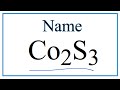
Naming and Charges of Cobalt Compounds

Interactive Video
•
Chemistry
•
9th - 10th Grade
•
Practice Problem
•
Hard

Jackson Turner
FREE Resource
Read more
8 questions
Show all answers
1.
MULTIPLE CHOICE QUESTION
30 sec • 1 pt
What type of metal is cobalt in the compound CO2S3?
Transition metal
Alkali metal
Alkaline earth metal
Noble gas
2.
MULTIPLE CHOICE QUESTION
30 sec • 1 pt
What is the first step in naming the compound CO2S3?
Write the name of the metal as it appears on the periodic table
Write the name of the non-metal
Determine the number of atoms
Identify the charge of the metal
3.
MULTIPLE CHOICE QUESTION
30 sec • 1 pt
How do you modify the name of the non-metal in CO2S3?
Keep it unchanged
Add 'ate' to the end
Replace the ending with 'ide'
Add 'ite' to the end
4.
MULTIPLE CHOICE QUESTION
30 sec • 1 pt
Why is it necessary to include the charge of cobalt in the name of CO2S3?
Because the compound is ionic
Because cobalt is a non-metal
Because sulfur has a variable charge
Because cobalt is a transition metal
5.
MULTIPLE CHOICE QUESTION
30 sec • 1 pt
What is the charge of sulfur in the compound CO2S3?
1-
2-
3-
4-
6.
MULTIPLE CHOICE QUESTION
30 sec • 1 pt
How is the charge of cobalt represented in the name of CO2S3?
With Arabic numerals
With asterisks
With Roman numerals
With Greek letters
7.
MULTIPLE CHOICE QUESTION
30 sec • 1 pt
What is the final name of the compound CO2S3?
Cobalt(V) Sulfide
Cobalt(III) Sulfide
Cobalt(II) Sulfide
Cobalt(IV) Sulfide
Access all questions and much more by creating a free account
Create resources
Host any resource
Get auto-graded reports

Continue with Google

Continue with Email

Continue with Classlink

Continue with Clever
or continue with

Microsoft
%20(1).png)
Apple

Others
Already have an account?

