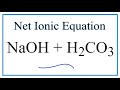
Understanding Net Ionic Equations

Interactive Video
•
Chemistry
•
9th - 10th Grade
•
Practice Problem
•
Hard

Amelia Wright
FREE Resource
Read more
10 questions
Show all answers
1.
MULTIPLE CHOICE QUESTION
30 sec • 1 pt
What is the first step in writing a balanced net ionic equation?
Split strong electrolytes into ions
Determine the states of substances
Balance the molecular equation
Identify spectator ions
2.
MULTIPLE CHOICE QUESTION
30 sec • 1 pt
Which of the following is true about sodium hydroxide in the reaction?
It forms a precipitate
It is a strong base and dissociates completely
It is a weak base and remains undissociated
It is insoluble in water
3.
MULTIPLE CHOICE QUESTION
30 sec • 1 pt
Why is carbonic acid considered a weak electrolyte?
It dissociates completely in water
It forms a strong acid
It does not dissociate into ions
It is insoluble in water
4.
MULTIPLE CHOICE QUESTION
30 sec • 1 pt
What is the significance of memorizing strong acids and bases?
To know which substances dissociate completely
To determine solubility
To balance molecular equations
To identify weak acids
5.
MULTIPLE CHOICE QUESTION
30 sec • 1 pt
In the complete ionic equation, which ions are considered spectator ions?
Sodium ions
Hydrogen ions
Hydroxide ions
Carbonate ions
6.
MULTIPLE CHOICE QUESTION
30 sec • 1 pt
What is the role of spectator ions in a chemical reaction?
They form new compounds
They remain unchanged and do not participate
They change the state of the reaction
They participate in the reaction
7.
MULTIPLE CHOICE QUESTION
30 sec • 1 pt
How is the net ionic equation derived from the complete ionic equation?
By balancing the charges
By adding more ions
By changing the states of substances
By removing spectator ions
Access all questions and much more by creating a free account
Create resources
Host any resource
Get auto-graded reports

Continue with Google

Continue with Email

Continue with Classlink

Continue with Clever
or continue with

Microsoft
%20(1).png)
Apple

Others
Already have an account?
Similar Resources on Wayground

11 questions
Solving Radical Equations and Quadratics
Interactive video
•
8th - 10th Grade
11 questions
Factoring Quadratic Expressions and Functions
Interactive video
•
8th - 10th Grade
11 questions
Understanding Exponent Properties
Interactive video
•
8th - 10th Grade
11 questions
Understanding Piecewise Defined Functions
Interactive video
•
8th - 10th Grade
11 questions
Direct and Inverse Variation Concepts
Interactive video
•
9th - 10th Grade
11 questions
Understanding Functions and Their Properties
Interactive video
•
9th - 10th Grade
11 questions
Graphing Complex Numbers and Concepts
Interactive video
•
9th - 10th Grade
10 questions
Understanding Quadratic Functions
Interactive video
•
8th - 10th Grade
Popular Resources on Wayground
15 questions
Fractions on a Number Line

Quiz
•
3rd Grade
20 questions
Equivalent Fractions
Quiz
•
3rd Grade
25 questions
Multiplication Facts
Quiz
•
5th Grade
54 questions
Analyzing Line Graphs & Tables
Quiz
•
4th Grade
22 questions
fractions
Quiz
•
3rd Grade
20 questions
Main Idea and Details
Quiz
•
5th Grade
20 questions
Context Clues
Quiz
•
6th Grade
15 questions
Equivalent Fractions
Quiz
•
4th Grade
Discover more resources for Chemistry
20 questions
Types of Chemical Reactions
Quiz
•
9th - 12th Grade
10 questions
Formative 3BC: Ionic v Covalent Bonds
Quiz
•
9th Grade
10 questions
Exploring Stoichiometry Concepts
Interactive video
•
6th - 10th Grade
20 questions
Mixed Bonding Naming
Quiz
•
9th Grade
20 questions
Naming & Writing Chemical Formulas
Quiz
•
10th Grade
20 questions
Chemical Reactions
Quiz
•
9th Grade
20 questions
Practice: E-Con, Orbital Notation, Noble Gas Notation
Quiz
•
10th Grade
20 questions
Covalent Bonding
Quiz
•
10th Grade