
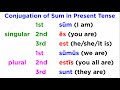
Understanding the Verb 'Sum' in Latin

Interactive Video
•
World Languages
•
9th - 10th Grade
•
Practice Problem
•
Hard

Amelia Wright
FREE Resource
Read more
10 questions
Show all answers
1.
MULTIPLE CHOICE QUESTION
30 sec • 1 pt
What makes the verb 'to be' different from regular verbs in Latin?
It has a regular conjugation pattern.
It is an auxiliary verb.
It has many irregularities and does not fit usual patterns.
It is only used in past tense.
2.
MULTIPLE CHOICE QUESTION
30 sec • 1 pt
Which forms are missing in the verb 'sum'?
Nominative, accusative, and dative cases.
Present, past, and future tenses.
Supine, gerund, and some participial forms.
All forms are present in 'sum'.
3.
MULTIPLE CHOICE QUESTION
30 sec • 1 pt
How many principal parts does 'sum' have?
Two
Four
One
Three
4.
MULTIPLE CHOICE QUESTION
30 sec • 1 pt
What is unique about the present tense conjugation of 'sum'?
It is only used in questions.
It only has one form.
It uses two different irregular stems.
It uses regular stems.
5.
MULTIPLE CHOICE QUESTION
30 sec • 1 pt
What does it mean that 'sum' is an intransitive verb?
It is always used with an adjective.
It can take a direct object.
It is only used in passive voice.
It cannot take a direct object.
6.
MULTIPLE CHOICE QUESTION
30 sec • 1 pt
In what case is the predicate when using 'sum'?
Genitive
Accusative
Nominative
Dative
7.
MULTIPLE CHOICE QUESTION
30 sec • 1 pt
How can 'sum' sometimes be translated?
As 'to make'
As 'to have'
As 'to exist' or 'to be there'
As 'to do'
Access all questions and much more by creating a free account
Create resources
Host any resource
Get auto-graded reports

Continue with Google

Continue with Email

Continue with Microsoft
or continue with

%20(1).png)
Apple

Others
By signing up, you agree to our Terms of Service & Privacy Policy
Already have an account?


