
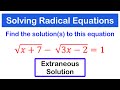
Solving Radical Equations and Verification

Interactive Video
•
Mathematics
•
9th - 10th Grade
•
Practice Problem
•
Hard

Thomas White
FREE Resource
Read more
9 questions
Show all answers
1.
MULTIPLE CHOICE QUESTION
30 sec • 1 pt
What is the first step in solving a radical equation?
Divide both sides by a variable
Remove the radical by squaring both sides
Multiply both sides by a constant
Add a constant to both sides
2.
MULTIPLE CHOICE QUESTION
30 sec • 1 pt
In the equation √(x² + 7) = 4, what is the result after squaring both sides?
x² + 7 = 8
x² + 7 = 4
x² + 7 = 16
x² + 7 = 0
3.
MULTIPLE CHOICE QUESTION
30 sec • 1 pt
What are extraneous solutions?
Solutions that are always positive
Solutions that satisfy the original equation
Solutions that are always negative
Solutions that do not satisfy the original equation
4.
MULTIPLE CHOICE QUESTION
30 sec • 1 pt
How do you verify if a solution is valid for a radical equation?
By checking if it is an integer
By checking if it is a negative number
By checking if it is a positive number
By checking if it satisfies the original equation
5.
MULTIPLE CHOICE QUESTION
30 sec • 1 pt
What is the equation for the second example?
√(x + 7) - √(3x - 2) = 1
√(x + 7) = √(3x - 2)
√(x + 7) + √(3x - 2) = 1
√(x + 7) = 1
6.
MULTIPLE CHOICE QUESTION
30 sec • 1 pt
Why do we transpose terms in the second example?
To divide the equation
To simplify the equation
To eliminate negative terms
To add more terms
7.
MULTIPLE CHOICE QUESTION
30 sec • 1 pt
What happens when you square both sides of the equation √(x + 7) = 1 + √(3x - 2)?
The radicals are eliminated
The equation becomes more complex
The equation remains the same
The equation becomes a linear equation
Access all questions and much more by creating a free account
Create resources
Host any resource
Get auto-graded reports

Continue with Google

Continue with Email

Continue with Microsoft
or continue with

%20(1).png)
Apple

Others
By signing up, you agree to our Terms of Service & Privacy Policy
Already have an account?

