
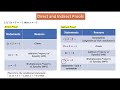
Indirect and Direct Proofs in Geometry

Interactive Video
•
Mathematics
•
9th - 10th Grade
•
Practice Problem
•
Hard

Thomas White
FREE Resource
Read more
12 questions
Show all answers
1.
MULTIPLE CHOICE QUESTION
30 sec • 1 pt
What is the primary characteristic of a direct proof?
It uses inductive reasoning.
It relies on empirical evidence.
It starts with premises assumed to be true.
It assumes the negation of the conclusion.
2.
MULTIPLE CHOICE QUESTION
30 sec • 1 pt
In a direct proof, what is the role of postulates and theorems?
They are used to assume the negation of the conclusion.
They are ignored in the proof process.
They help establish the conclusion logically.
They are used to contradict the premises.
3.
MULTIPLE CHOICE QUESTION
30 sec • 1 pt
What is the first step in proving the statement 'If 2x + 5 = -1, then x = -3' using direct proof?
Multiply both sides by 2.
Simplify the equation by adding 5.
Assume x is not -3.
Start with the given equation 2x + 5 = -1.
4.
MULTIPLE CHOICE QUESTION
30 sec • 1 pt
Which property is used to simplify the equation 2x + 5 = -1 to 2x = -6?
Addition property of equality
Multiplication property of equality
Division property of equality
Subtraction property of equality
5.
MULTIPLE CHOICE QUESTION
30 sec • 1 pt
What is the final step in the direct proof of the statement 'If 2x + 5 = -1, then x = -3'?
Add 5 to both sides.
Multiply both sides by 1/2.
Subtract 5 from both sides.
Assume x is not -3.
6.
MULTIPLE CHOICE QUESTION
30 sec • 1 pt
In the indirect proof of 'If 2x + 5 = -1, then x = -3', what is assumed?
2x + 5 is not equal to -1.
2x is equal to 6.
x is not equal to -3.
x is equal to -3.
7.
MULTIPLE CHOICE QUESTION
30 sec • 1 pt
What indicates a contradiction in an indirect proof?
The premises are proven false.
The conclusion is proven true.
The assumption leads to a logical inconsistency.
The assumption is proven true.
Access all questions and much more by creating a free account
Create resources
Host any resource
Get auto-graded reports

Continue with Google

Continue with Email

Continue with Classlink

Continue with Clever
or continue with

Microsoft
%20(1).png)
Apple

Others
Already have an account?
Popular Resources on Wayground

15 questions
Fractions on a Number Line

Quiz
•
3rd Grade
20 questions
Equivalent Fractions
Quiz
•
3rd Grade
25 questions
Multiplication Facts
Quiz
•
5th Grade
29 questions
Alg. 1 Section 5.1 Coordinate Plane
Quiz
•
9th Grade
22 questions
fractions
Quiz
•
3rd Grade
11 questions
FOREST Effective communication

Lesson
•
KG
20 questions
Main Idea and Details
Quiz
•
5th Grade
20 questions
Context Clues
Quiz
•
6th Grade
Discover more resources for Mathematics
29 questions
Alg. 1 Section 5.1 Coordinate Plane
Quiz
•
9th Grade
20 questions
Graphing Inequalities on a Number Line
Quiz
•
6th - 9th Grade
20 questions
Box and Whisker Plots
Quiz
•
9th Grade
18 questions
Exponential Growth and Decay
Quiz
•
9th Grade
20 questions
Function or Not a Function
Quiz
•
8th - 9th Grade
20 questions
SSS/SAS
Quiz
•
9th - 12th Grade
14 questions
Making Inferences From Samples
Quiz
•
7th - 12th Grade
23 questions
CCG - CH8 Polygon angles and area Review
Quiz
•
9th - 12th Grade