
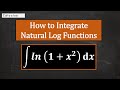
Integration Techniques and Natural Logarithms

Interactive Video
•
Mathematics
•
11th - 12th Grade
•
Practice Problem
•
Hard

Thomas White
FREE Resource
Read more
11 questions
Show all answers
1.
MULTIPLE CHOICE QUESTION
30 sec • 1 pt
What is the main focus of the video?
Solving quadratic equations
Exploring polynomial functions
Learning about trigonometric identities
Understanding natural logarithms
2.
MULTIPLE CHOICE QUESTION
30 sec • 1 pt
What is the result of integrating e^x?
ln(x) + C
e^x + C
x^2 + C
1/x + C
3.
MULTIPLE CHOICE QUESTION
30 sec • 1 pt
What is the derivative of ln(x)?
x
1/x
ln(x)
e^x
4.
MULTIPLE CHOICE QUESTION
30 sec • 1 pt
Why can't natural logarithms be directly integrated at this level?
They require advanced calculus techniques
They are undefined
They are already in simplest form
They are not continuous
5.
MULTIPLE CHOICE QUESTION
30 sec • 1 pt
What technique is introduced to handle integration of natural logarithms?
Partial fraction decomposition
Integration by parts
Trigonometric substitution
Numerical integration
6.
MULTIPLE CHOICE QUESTION
30 sec • 1 pt
In integration by parts, what do you do with the natural log function?
Multiply it by a constant
Ignore it
Differentiate it
Integrate it
7.
MULTIPLE CHOICE QUESTION
30 sec • 1 pt
What is the formula for integration by parts?
∫udv = uv - ∫vdu
∫udv = uv + ∫vdu
∫udv = uv - ∫udv
∫udv = u/v - ∫vdu
Access all questions and much more by creating a free account
Create resources
Host any resource
Get auto-graded reports

Continue with Google

Continue with Email

Continue with Microsoft
or continue with

%20(1).png)
Apple

Others
By signing up, you agree to our Terms of Service & Privacy Policy
Already have an account?


