
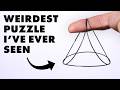
Mathematical Knots and Their Properties

Interactive Video
•
Mathematics
•
9th - 10th Grade
•
Practice Problem
•
Hard
Thomas White
FREE Resource
Read more
11 questions
Show all answers
1.
MULTIPLE CHOICE QUESTION
30 sec • 1 pt
Who invented the puzzle discussed in the video?
Joel Langer
William Thompson
Michele Vidulis
Mark Pauley
2.
MULTIPLE CHOICE QUESTION
30 sec • 1 pt
What is the main challenge of the puzzle?
To cut the wire into pieces
To take the wire out of the bag and put it back
To fold the wire into a square
To untangle the wire
3.
MULTIPLE CHOICE QUESTION
30 sec • 1 pt
What distinguishes a mathematical knot from a regular knot?
Mathematical knots have loose ends
Regular knots are always stable
Regular knots are made of elastic material
Mathematical knots are loops that can't be untangled
4.
MULTIPLE CHOICE QUESTION
30 sec • 1 pt
What material is used to create the physical realization of mathematical knots in the video?
Copper wire
Nitinol wire
Plastic string
Steel cable
5.
MULTIPLE CHOICE QUESTION
30 sec • 1 pt
What is a stable configuration in the context of elastic knots?
A configuration that is always flat
A configuration that is a local energy minimum
A configuration that is always symmetrical
A configuration that doesn't change shape
6.
MULTIPLE CHOICE QUESTION
30 sec • 1 pt
How do Mark and Michele find stable configurations of knots?
By using 3D simulation software
By cutting the knots
By manually adjusting the knots
By using a periodic table of elements
7.
MULTIPLE CHOICE QUESTION
30 sec • 1 pt
What is the significance of the figure 8 knot in the video?
It is the simplest knot
It has three different stable configurations
It cannot be made from nitinol
It is the most complex knot
Access all questions and much more by creating a free account
Create resources
Host any resource
Get auto-graded reports

Continue with Google

Continue with Email

Continue with Microsoft
or continue with

%20(1).png)
Apple

Others
By signing up, you agree to our Terms of Service & Privacy Policy
Already have an account?

