
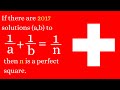
Perfect Squares and Factor Pairs

Interactive Video
•
Mathematics
•
9th - 10th Grade
•
Practice Problem
•
Hard

Thomas White
FREE Resource
Read more
8 questions
Show all answers
1.
MULTIPLE CHOICE QUESTION
30 sec • 1 pt
What is the main goal of the problem from the 2017 Swiss Math Olympiad?
To find the value of n
To prove that n is a perfect square
To determine the number of ordered pairs
To solve for a specific value of a and b
2.
MULTIPLE CHOICE QUESTION
30 sec • 1 pt
What is the hint provided to solve the problem?
Guess the value of n
Relate solutions to factor pairs of N squared
Find a specific value of n
Use a different equation
3.
MULTIPLE CHOICE QUESTION
30 sec • 1 pt
What is the first step in the solution process?
Clear fractions by multiplying by a, b, and n
Use a calculator
Solve for a specific value of n
Guess the values of a and b
4.
MULTIPLE CHOICE QUESTION
30 sec • 1 pt
What is the purpose of the factoring trick introduced in the solution?
To simplify the equation
To transform the equation into a factorable form
To find the value of n
To eliminate variables
5.
MULTIPLE CHOICE QUESTION
30 sec • 1 pt
What does the one-to-one correspondence establish?
A relationship between n and b
A relationship between a and b
A relationship between solutions and factor pairs of N squared
A relationship between n and a
6.
MULTIPLE CHOICE QUESTION
30 sec • 1 pt
How are factor pairs of N squared rewritten?
As ordered pairs of a and b
As divisors of N squared
As multiples of n
As sums of a and b
7.
MULTIPLE CHOICE QUESTION
30 sec • 1 pt
What theorem is used to express N as a product of primes?
Fermat's Last Theorem
Pythagorean Theorem
Fundamental Theorem of Arithmetic
Binomial Theorem
Access all questions and much more by creating a free account
Create resources
Host any resource
Get auto-graded reports

Continue with Google

Continue with Email

Continue with Microsoft
or continue with

%20(1).png)
Apple

Others
By signing up, you agree to our Terms of Service & Privacy Policy
Already have an account?

