
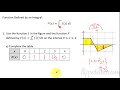
Fundamental Theorems of Calculus

Interactive Video
•
Mathematics
•
11th - 12th Grade
•
Practice Problem
•
Hard

Thomas White
FREE Resource
Read more
10 questions
Show all answers
1.
MULTIPLE CHOICE QUESTION
30 sec • 1 pt
What is the main topic of today's lesson?
The First Fundamental Theorem of Calculus
The Second Fundamental Theorem of Calculus
The Intermediate Value Theorem
The Mean Value Theorem
2.
MULTIPLE CHOICE QUESTION
30 sec • 1 pt
How is a function defined by an integral in this lesson?
By using a constant as the lower bound
By using a constant as the upper bound
By using a variable as either the lower or upper bound
By using a variable as both bounds
3.
MULTIPLE CHOICE QUESTION
30 sec • 1 pt
What happens when the lower and upper bounds of an integral are the same?
The integral is undefined
The integral equals 0
The integral equals the function value
The integral equals 1
4.
MULTIPLE CHOICE QUESTION
30 sec • 1 pt
What is the value of the integral from 0 to 1 of f(t) if the area under the curve is 1?
3
2
0
1
5.
MULTIPLE CHOICE QUESTION
30 sec • 1 pt
How do you determine the minimum value of a function defined by an integral?
By finding where the derivative is zero
By evaluating the function at the endpoints
By finding the maximum area under the curve
By setting the integral equal to zero
6.
MULTIPLE CHOICE QUESTION
30 sec • 1 pt
What is the maximum value of the function in the example provided?
At x = 2
At x = 0
At x = 4
At x = 1.5
7.
MULTIPLE CHOICE QUESTION
30 sec • 1 pt
What is the result of taking the derivative of an integral?
The integral itself
Zero
A constant
The original function
Access all questions and much more by creating a free account
Create resources
Host any resource
Get auto-graded reports

Continue with Google

Continue with Email

Continue with Microsoft
or continue with

%20(1).png)
Apple

Others
By signing up, you agree to our Terms of Service & Privacy Policy
Already have an account?

