
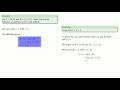
Understanding Addition and Set Theory

Interactive Video
•
Mathematics
•
9th - 10th Grade
•
Practice Problem
•
Hard

Thomas White
FREE Resource
Read more
10 questions
Show all answers
1.
MULTIPLE CHOICE QUESTION
30 sec • 1 pt
What is the primary concept introduced in the beginning of the video?
Division of sets
Addition using cardinality
Subtraction using cardinality
Multiplication of whole numbers
2.
MULTIPLE CHOICE QUESTION
30 sec • 1 pt
How is addition initially defined in terms of sets?
As the product of two sets
As the union of two sets
As the difference between two sets
As the intersection of two sets
3.
MULTIPLE CHOICE QUESTION
30 sec • 1 pt
What is the result of 2 + 3 according to the initial proof?
7
6
5
4
4.
MULTIPLE CHOICE QUESTION
30 sec • 1 pt
Why are definitions crucial in mathematics?
They are optional guidelines
They provide a foundation for proofs
They are not important
They are only used in advanced math
5.
MULTIPLE CHOICE QUESTION
30 sec • 1 pt
What does it mean for an operation to be well-defined?
The operation is complex
The result changes with different representations
The result is independent of representations
The operation is undefined
6.
MULTIPLE CHOICE QUESTION
30 sec • 1 pt
What issue arises with the initial definition of addition?
It is not well-defined
It is too complex
It is not applicable to all numbers
It is too simple
7.
MULTIPLE CHOICE QUESTION
30 sec • 1 pt
What condition is added in the corrected definition of addition?
Sets must be equal in size
Sets must have an empty intersection
Sets must be identical
Sets must be disjoint
Access all questions and much more by creating a free account
Create resources
Host any resource
Get auto-graded reports

Continue with Google

Continue with Email

Continue with Classlink

Continue with Clever
or continue with

Microsoft
%20(1).png)
Apple

Others
Already have an account?


