
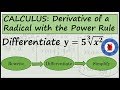
Differentiation of Radical Functions

Interactive Video
•
Mathematics
•
9th - 10th Grade
•
Practice Problem
•
Hard

Thomas White
FREE Resource
Read more
15 questions
Show all answers
1.
MULTIPLE CHOICE QUESTION
30 sec • 1 pt
What is the first step in finding the derivative of a function with a variable under a radical sign?
Rewrite the function with the variable as the base of an exponent.
Apply the quotient rule.
Use the chain rule.
Directly differentiate the function.
2.
MULTIPLE CHOICE QUESTION
30 sec • 1 pt
Which rule is primarily used to differentiate a function with a single term under a radical sign?
Quotient rule
Power rule
Chain rule
Product rule
3.
MULTIPLE CHOICE QUESTION
30 sec • 1 pt
How do you express the cube root of x squared using exponents?
x^1/3
x^2/3
x^3
x^3/2
4.
MULTIPLE CHOICE QUESTION
30 sec • 1 pt
What is the equivalent expression for the nth root of a variable raised to the m power?
a^(m+n)
a^(m-n)
a^(m/n)
a^(n/m)
5.
MULTIPLE CHOICE QUESTION
30 sec • 1 pt
Why is it beneficial to convert a function from radical to exponential form before differentiating?
It eliminates the need for simplification.
It reduces the number of terms.
It simplifies the application of the power rule.
It makes integration easier.
6.
MULTIPLE CHOICE QUESTION
30 sec • 1 pt
What is the next step after rewriting the function in terms of exponents?
Apply the chain rule.
Convert back to radical form.
Differentiate using the power rule.
Simplify the expression.
7.
MULTIPLE CHOICE QUESTION
30 sec • 1 pt
According to the power rule, what is the derivative of x^n?
n * x^(n+1)
n * x^(n-1)
x^(n-1)
n * x^n
Access all questions and much more by creating a free account
Create resources
Host any resource
Get auto-graded reports

Continue with Google

Continue with Email

Continue with Classlink

Continue with Clever
or continue with

Microsoft
%20(1).png)
Apple

Others
Already have an account?

