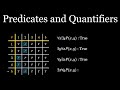
Logic and Predicate Concepts

Interactive Video
•
Mathematics
•
9th - 10th Grade
•
Practice Problem
•
Hard

Thomas White
FREE Resource
Read more
14 questions
Show all answers
1.
MULTIPLE CHOICE QUESTION
30 sec • 1 pt
What is a predicate in the context of logic?
A sentence that is always true
A sentence that is always false
A sentence that includes free variables
A sentence with no variables
2.
MULTIPLE CHOICE QUESTION
30 sec • 1 pt
What happens when you insert a value into a free variable of a predicate?
It becomes a hypothesis
It becomes a proposition
It becomes a theorem
It becomes a conjecture
3.
MULTIPLE CHOICE QUESTION
30 sec • 1 pt
Why do we set a universe of discourse for predicate variables?
To make predicates always true
To limit the range of values for variables
To avoid using numbers in predicates
To ensure predicates are always false
4.
MULTIPLE CHOICE QUESTION
30 sec • 1 pt
What is the universe of discourse in the given example?
Set of real numbers
Set of complex numbers
Set of integers
Set of counting numbers
5.
MULTIPLE CHOICE QUESTION
30 sec • 1 pt
What does the existential quantifier signify?
Exactly one value makes the predicate true
At least one value makes the predicate true
No values make the predicate true
All values make the predicate true
6.
MULTIPLE CHOICE QUESTION
30 sec • 1 pt
How is the universal quantifier represented?
A backwards E
A question mark
An upside down A
A forward slash
7.
MULTIPLE CHOICE QUESTION
30 sec • 1 pt
What does the universal quantifier require?
At least one value makes the predicate true
All values make the predicate true
No values make the predicate true
Some values make the predicate true
Access all questions and much more by creating a free account
Create resources
Host any resource
Get auto-graded reports

Continue with Google

Continue with Email

Continue with Classlink

Continue with Clever
or continue with

Microsoft
%20(1).png)
Apple

Others
Already have an account?
Similar Resources on Wayground

10 questions
Indefinite Adjectives and Pronouns in Italian
Interactive video
•
9th - 10th Grade
11 questions
Understanding Categorical Logic: Adduction and Its Types
Interactive video
•
9th - 10th Grade
9 questions
Balancing Chemical Equations Concepts
Interactive video
•
9th - 10th Grade
6 questions
Understanding Groups in Mathematics
Interactive video
•
9th - 10th Grade
8 questions
Balancing Chemical Equations Concepts
Interactive video
•
9th - 10th Grade
11 questions
Understanding Mertens Function and Conjecture
Interactive video
•
9th - 12th Grade
11 questions
Understanding Proof by Contradiction
Interactive video
•
9th - 12th Grade
11 questions
Understanding Integrals and Symmetry
Interactive video
•
9th - 10th Grade
Popular Resources on Wayground
7 questions
History of Valentine's Day
Interactive video
•
4th Grade
15 questions
Fractions on a Number Line

Quiz
•
3rd Grade
20 questions
Equivalent Fractions
Quiz
•
3rd Grade
25 questions
Multiplication Facts
Quiz
•
5th Grade
22 questions
fractions
Quiz
•
3rd Grade
15 questions
Valentine's Day Trivia
Quiz
•
3rd Grade
20 questions
Main Idea and Details
Quiz
•
5th Grade
20 questions
Context Clues
Quiz
•
6th Grade
Discover more resources for Mathematics
20 questions
Graphing Inequalities on a Number Line
Quiz
•
6th - 9th Grade
20 questions
Exponent Properties
Quiz
•
9th Grade
15 questions
Combine Like Terms and Distributive Property
Quiz
•
8th - 9th Grade
20 questions
Function or Not a Function
Quiz
•
8th - 9th Grade
10 questions
Factor Quadratic Expressions with Various Coefficients
Quiz
•
9th - 12th Grade
10 questions
Elijah McCoy: Innovations and Impact in Black History
Interactive video
•
6th - 10th Grade
21 questions
Factoring Trinomials (a=1)
Quiz
•
9th Grade
5 questions
Triangle Congruence Theorems
Interactive video
•
9th - 12th Grade