
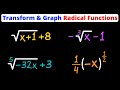
Transformations of Radical Functions

Interactive Video
•
Mathematics
•
9th - 10th Grade
•
Practice Problem
•
Hard
Thomas White
FREE Resource
Read more
18 questions
Show all answers
1.
MULTIPLE CHOICE QUESTION
30 sec • 1 pt
What is the general shape of the graph for the parent function f(x) = √x?
A circle
A straight line
A curve starting at the origin
A parabola
2.
MULTIPLE CHOICE QUESTION
30 sec • 1 pt
How does the graph of f(x) = ∛x differ from f(x) = √x?
It forms a closed loop
It is symmetric about the y-axis
It is a straight line
It extends in both directions
3.
MULTIPLE CHOICE QUESTION
30 sec • 1 pt
What is the graphical appearance of an even root function like f(x) = ⁴√x?
Similar to a square root function
Similar to a cube root function
A straight line
A closed loop
4.
MULTIPLE CHOICE QUESTION
30 sec • 1 pt
How do odd root functions like f(x) = ⁵√x appear graphically?
Similar to a square root function
A closed loop
Similar to a cube root function
A straight line
5.
MULTIPLE CHOICE QUESTION
30 sec • 1 pt
What is the effect of adding a constant inside the radical, such as in f(x) = √(x - 2)?
Reflects the graph
Shifts the graph down
Shifts the graph up
Shifts the graph left or right
6.
MULTIPLE CHOICE QUESTION
30 sec • 1 pt
How does adding a constant outside the radical, like in f(x) = √x + 3, affect the graph?
Shifts the graph up or down
Stretches the graph
Shifts the graph left or right
Reflects the graph
7.
MULTIPLE CHOICE QUESTION
30 sec • 1 pt
What happens when a negative sign is placed outside the radical, as in f(x) = -√x?
Reflects across the y-axis
Reflects across the x-axis
Shifts the graph up
Shifts the graph down
Access all questions and much more by creating a free account
Create resources
Host any resource
Get auto-graded reports

Continue with Google

Continue with Email

Continue with Microsoft
or continue with

%20(1).png)
Apple

Others
By signing up, you agree to our Terms of Service & Privacy Policy
Already have an account?

