
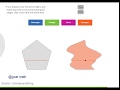
Understanding Ellipses and Area Principles

Interactive Video
•
Mathematics
•
6th - 8th Grade
•
Practice Problem
•
Hard
Thomas White
FREE Resource
Read more
8 questions
Show all answers
1.
MULTIPLE CHOICE QUESTION
30 sec • 1 pt
What shape do you get when you stretch a circle?
Rectangle
Ellipse
Square
Triangle
2.
MULTIPLE CHOICE QUESTION
30 sec • 1 pt
Which of these shapes is an ellipse?
Rectangle
Circle
Square
Triangle
3.
MULTIPLE CHOICE QUESTION
30 sec • 1 pt
What is the longest line segment through the center of an ellipse called?
Minor Axis
Diameter
Radius
Major Axis
4.
MULTIPLE CHOICE QUESTION
30 sec • 1 pt
How are the major and minor axes of an ellipse oriented?
Parallel
At 30 degrees
Perpendicular
At 45 degrees
5.
MULTIPLE CHOICE QUESTION
30 sec • 1 pt
What is each half of the major axis known as?
Diameter
Semi-minor axis
Semi-major axis
Radius
6.
MULTIPLE CHOICE QUESTION
30 sec • 1 pt
What is the area of a circle with radius R?
πR
πR²
2πR
R²
7.
MULTIPLE CHOICE QUESTION
30 sec • 1 pt
What principle helps find the area of shapes by rearranging slices?
Pythagorean Theorem
Cavalieri's Principle
Pascal's Law
Archimedes' Principle
Access all questions and much more by creating a free account
Create resources
Host any resource
Get auto-graded reports

Continue with Google

Continue with Email

Continue with Microsoft
or continue with

%20(1).png)
Apple

Others
By signing up, you agree to our Terms of Service & Privacy Policy
Already have an account?

