
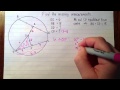
Chord Properties and Pythagorean Theorem

Interactive Video
•
Mathematics
•
9th - 10th Grade
•
Practice Problem
•
Hard

Thomas White
FREE Resource
Read more
22 questions
Show all answers
1.
MULTIPLE CHOICE QUESTION
30 sec • 1 pt
What is the main objective of the video tutorial?
To learn about different types of triangles
To combine chord properties with the Pythagorean theorem
To understand the history of the Pythagorean theorem
To explore different circle theorems
2.
MULTIPLE CHOICE QUESTION
30 sec • 1 pt
What are the known measurements given in the problem?
OD = 12, AB = 9
OD = 6, AB = 18
OD = 18, AB = 6
OD = 9, AB = 12
3.
MULTIPLE CHOICE QUESTION
30 sec • 1 pt
What is the relationship between chords that are equidistant from the center?
They are parallel
They are perpendicular
They are of different lengths
They are of equal length
4.
MULTIPLE CHOICE QUESTION
30 sec • 1 pt
If AB is 18, what is the length of CD?
36
27
18
9
5.
MULTIPLE CHOICE QUESTION
30 sec • 1 pt
What does the perpendicular bisector property of a chord state?
It doubles the length of the chord
It divides the chord into three equal parts
It has no effect on the chord
It bisects the chord into two equal parts
6.
MULTIPLE CHOICE QUESTION
30 sec • 1 pt
What is the length of each half of the chord if the full length is 18?
15
12
9
6
7.
MULTIPLE CHOICE QUESTION
30 sec • 1 pt
Which theorem is used to find the length of OD?
Theorem of Similar Triangles
Pythagorean Theorem
Theorem of Parallel Lines
Theorem of Congruent Angles
Access all questions and much more by creating a free account
Create resources
Host any resource
Get auto-graded reports

Continue with Google

Continue with Email

Continue with Classlink

Continue with Clever
or continue with

Microsoft
%20(1).png)
Apple

Others
Already have an account?

