
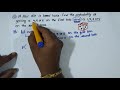
Probability of Rolling Dice

Interactive Video
•
Mathematics
•
9th - 10th Grade
•
Hard

Thomas White
FREE Resource
Read more
30 questions
Show all answers
1.
MULTIPLE CHOICE QUESTION
30 sec • 1 pt
What is a common type of problem in probability theory discussed in the video?
Rolling a fair die
Flipping a coin
Choosing colored balls from a bag
Drawing cards from a deck
2.
MULTIPLE CHOICE QUESTION
30 sec • 1 pt
Why is the problem of rolling a fair die relevant in competitive exams?
It is a basic problem that tests fundamental understanding.
It is not relevant to real-world applications.
It is rarely seen in exams.
It is only used in advanced probability courses.
3.
MULTIPLE CHOICE QUESTION
30 sec • 1 pt
What is the probability problem discussed in the video?
Finding the probability of getting a 6 on the first toss and a 1 on the second toss.
Finding the probability of getting an even number on both tosses.
Finding the probability of getting a 1 on both tosses.
Finding the probability of getting a 4, 5, or 6 on the first toss and a 1, 2, 3, or 4 on the second toss.
4.
MULTIPLE CHOICE QUESTION
30 sec • 1 pt
What is the first step in solving probability problems according to the video?
Calculating the total outcomes
Writing down the events
Guessing the answer
Drawing a probability tree
5.
MULTIPLE CHOICE QUESTION
30 sec • 1 pt
What does event A1 represent in the problem?
Getting an odd number on the first toss
Getting a 6 on both tosses
Getting a 1, 2, 3, or 4 on the second toss
Getting a 4, 5, or 6 on the first toss
6.
MULTIPLE CHOICE QUESTION
30 sec • 1 pt
What does event A2 represent in the problem?
Getting a 1 on both tosses
Getting a 4, 5, or 6 on the first toss
Getting an even number on the second toss
Getting a 1, 2, 3, or 4 on the second toss
7.
MULTIPLE CHOICE QUESTION
30 sec • 1 pt
How is the probability of A1 and A2 expressed in terms of intersection?
P(A1) * P(A2 | A1)
P(A1) + P(A2)
P(A1) / P(A2)
P(A1) - P(A2)
Access all questions and much more by creating a free account
Create resources
Host any resource
Get auto-graded reports

Continue with Google

Continue with Email

Continue with Classlink

Continue with Clever
or continue with

Microsoft
%20(1).png)
Apple

Others
Already have an account?


