
- Resource Library
- Math
- Geometry
- Triangle Proportionality Theorem
- Triangle Similarity And Proportionality Concepts
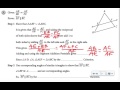
Triangle Similarity and Proportionality Concepts

Interactive Video
•
Mathematics
•
9th - 10th Grade
•
Hard

Thomas White
FREE Resource
Read more
11 questions
Show all answers
1.
MULTIPLE CHOICE QUESTION
30 sec • 1 pt
What is the main focus of using similar triangles in this lesson?
To find the area of triangles
To determine the angles of triangles
To find proportional segments that aren't necessarily sides
To calculate the perimeter of triangles
2.
MULTIPLE CHOICE QUESTION
30 sec • 1 pt
Why are EF and BC considered parallel in the construction?
Because they are the same length
Due to the congruence of corresponding angles
Due to the similarity of triangles
Because they are perpendicular to each other
3.
MULTIPLE CHOICE QUESTION
30 sec • 1 pt
What is the approximate decimal value of the ratio AE/EB?
1.5
1.91
2.0
1.75
4.
MULTIPLE CHOICE QUESTION
30 sec • 1 pt
How can triangle AEF be shown to be similar to triangle ABC?
By using the side-angle-side similarity
By using the angle-angle similarity
By using the angle-side-angle similarity
By using the side-side-side similarity
5.
MULTIPLE CHOICE QUESTION
30 sec • 1 pt
What theorem is used to conclude that a line parallel to a side of a triangle divides the other two sides into proportional segments?
Angle Bisector Theorem
Triangle Proportionality Theorem
Pythagorean Theorem
Midpoint Theorem
6.
MULTIPLE CHOICE QUESTION
30 sec • 1 pt
How can triangle similarity be concluded without using angles three and four?
By using the side-angle-side similarity
By using the angle-side-angle similarity
By using the side-side-side similarity
By using the reflexive property of angle A
7.
MULTIPLE CHOICE QUESTION
30 sec • 1 pt
What method is suggested for solving proportions in the example of finding segment lengths?
Using the Pythagorean theorem
Using the sine rule
Cross-multiplying
Using the quadratic formula
Access all questions and much more by creating a free account
Create resources
Host any resource
Get auto-graded reports

Continue with Google

Continue with Email

Continue with Microsoft
or continue with

%20(1).png)
Apple

Others
By signing up, you agree to our Terms of Service & Privacy Policy
Already have an account?

