
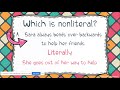
Understanding Idioms and Non-Literal Language

Interactive Video
•
English
•
4th - 5th Grade
•
Practice Problem
•
Hard

Richard Gonzalez
FREE Resource
Read more
15 questions
Show all answers
1.
MULTIPLE CHOICE QUESTION
30 sec • 1 pt
What is the main difference between literal and non-literal language?
Non-literal language is always true.
Literal language means exactly what it says.
Non-literal language means exactly what it says.
Literal language uses metaphors.
2.
MULTIPLE CHOICE QUESTION
30 sec • 1 pt
Which of the following is an example of literal language?
She has a heart of gold.
He is a night owl.
It's raining cats and dogs.
The sky is blue.
3.
MULTIPLE CHOICE QUESTION
30 sec • 1 pt
What question can help you determine if a statement is non-literal?
Does it rhyme?
Is it a metaphor?
Is it a simile?
Could it really happen?
4.
MULTIPLE CHOICE QUESTION
30 sec • 1 pt
If someone says, 'I'll start studying when pigs fly,' what do they mean?
They will study soon.
They will never study.
They love pigs.
They are studying now.
5.
MULTIPLE CHOICE QUESTION
30 sec • 1 pt
What does the phrase 'my book weighs a ton' imply?
The book is very light.
The book is very heavy.
The book is new.
The book is old.
6.
MULTIPLE CHOICE QUESTION
30 sec • 1 pt
What does it mean if someone is described as 'mule-headed'?
They are very fast.
They are very stubborn.
They are very kind.
They are very intelligent.
7.
MULTIPLE CHOICE QUESTION
30 sec • 1 pt
What does the phrase 'shake a leg' mean?
Move faster.
Dance quickly.
Sit down.
Stand still.
Access all questions and much more by creating a free account
Create resources
Host any resource
Get auto-graded reports

Continue with Google

Continue with Email

Continue with Classlink

Continue with Clever
or continue with

Microsoft
%20(1).png)
Apple

Others
Already have an account?

