
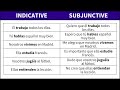
Understanding Indicative and Subjunctive Moods in Spanish

Interactive Video
•
World Languages
•
9th - 10th Grade
•
Practice Problem
•
Hard

Jennifer Brown
FREE Resource
10 questions
Show all answers
1.
MULTIPLE CHOICE QUESTION
30 sec • 1 pt
Which sentence is an example of the subjunctive mood?
Él trabaja todos los días.
Nosotros vivimos en Madrid.
Espero que tú hables español muy bien.
Ella estudia francés.
2.
MULTIPLE CHOICE QUESTION
30 sec • 1 pt
Which verb form is used in the indicative mood for 'él' in the sentence 'Él trabaja todos los días'?
Trabajemos
Trabaje
Trabajas
Trabaja
3.
MULTIPLE CHOICE QUESTION
30 sec • 1 pt
What is the indicative verb form for 'nosotros' in the sentence 'Nosotros vivimos en Madrid'?
Vivamos
Viven
Vivimos
Vivo
4.
MULTIPLE CHOICE QUESTION
30 sec • 1 pt
What is the primary use of the indicative mood in Spanish?
To describe facts and reality
To express emotions
To talk about hypothetical situations
To express wishes and desires
5.
MULTIPLE CHOICE QUESTION
30 sec • 1 pt
In the sentence 'Quiero que él trabaje todos los días', what does 'quiero que' indicate?
A question
A past event
A statement of fact
A wish or desire
6.
MULTIPLE CHOICE QUESTION
30 sec • 1 pt
What is a common feature of sentences in the subjunctive mood?
They always start with a question word.
They describe actions that are certain.
They are used to express past events.
They often include a main clause and a subordinate clause.
7.
MULTIPLE CHOICE QUESTION
30 sec • 1 pt
What is the role of the word 'que' in subjunctive sentences?
It connects the main clause to the subordinate clause.
It is used to express certainty.
It indicates a past event.
It introduces a question.
Access all questions and much more by creating a free account
Create resources
Host any resource
Get auto-graded reports

Continue with Google

Continue with Email

Continue with Classlink

Continue with Clever
or continue with

Microsoft
%20(1).png)
Apple

Others
Already have an account?

