
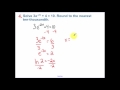
Understanding Base e and Natural Logarithms

Interactive Video
•
Mathematics
•
9th - 10th Grade
•
Hard

Jennifer Brown
FREE Resource
10 questions
Show all answers
1.
MULTIPLE CHOICE QUESTION
30 sec • 1 pt
What happens to the function e^x when the exponent is negative?
It remains unchanged.
It becomes a quadratic function.
It represents exponential decay.
It becomes a linear function.
2.
MULTIPLE CHOICE QUESTION
30 sec • 1 pt
Which of the following represents an exponential growth model?
x^2
e^(-x)
ln(x)
e^(x)
3.
MULTIPLE CHOICE QUESTION
30 sec • 1 pt
How are the graphs of e^x and ln(x) related?
They are parallel.
They are identical.
They are perpendicular.
They are symmetric across the line y=x.
4.
MULTIPLE CHOICE QUESTION
30 sec • 1 pt
What is the equivalent logarithmic form of e^x = 25?
ln(25) = x
log(25) = x
ln(x) = 25
log(x) = 25
5.
MULTIPLE CHOICE QUESTION
30 sec • 1 pt
What is the value of ln(e)?
0
1
e
Undefined
6.
MULTIPLE CHOICE QUESTION
30 sec • 1 pt
Which button on a calculator is used to access the e^x function?
The exp button
The log button
The ln button
The second function of the ln button
7.
MULTIPLE CHOICE QUESTION
30 sec • 1 pt
What is the formula used for continuously compounded interest?
A = P(1 + r/n)^(nt)
A = P(1 + r)^t
A = P(1 + rt)
A = Pe^(rt)
Access all questions and much more by creating a free account
Create resources
Host any resource
Get auto-graded reports

Continue with Google

Continue with Email

Continue with Microsoft
or continue with

%20(1).png)
Apple

Others
Already have an account?


