
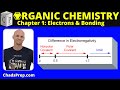
Understanding Polarity and Dipole Moments

Interactive Video
•
Chemistry
•
10th - 12th Grade
•
Practice Problem
•
Hard

Evelyn Hayes
FREE Resource
10 questions
Show all answers
1.
MULTIPLE CHOICE QUESTION
30 sec • 1 pt
What determines whether a bond is ionic, polar covalent, or nonpolar covalent?
The temperature at which the bond forms
The number of atoms in the molecule
The difference in electronegativity between the atoms
The size of the atoms involved
2.
MULTIPLE CHOICE QUESTION
30 sec • 1 pt
Which of the following bonds is considered nonpolar covalent?
Carbon-carbon
Carbon-nitrogen
Sodium-chlorine
Carbon-oxygen
3.
MULTIPLE CHOICE QUESTION
30 sec • 1 pt
A carbon-hydrogen bond is classified as:
Ionic
Polar covalent
Nonpolar covalent
Metallic
4.
MULTIPLE CHOICE QUESTION
30 sec • 1 pt
Which bond is right at the cusp of being polar?
Carbon-nitrogen
Sodium-chlorine
Carbon-carbon
Carbon-fluorine
5.
MULTIPLE CHOICE QUESTION
30 sec • 1 pt
What is the electronegativity difference for a carbon-fluorine bond?
2.0
1.5
1.0
0.5
6.
MULTIPLE CHOICE QUESTION
30 sec • 1 pt
Which of the following is an example of an ionic bond?
Carbon-carbon
Carbon-hydrogen
Carbon-nitrogen
Sodium-chlorine
7.
MULTIPLE CHOICE QUESTION
30 sec • 1 pt
What is the dipole moment a product of?
The difference in atomic radii
The sum of the atomic masses
The product of partial charges and distance of separation
The sum of electronegativities
Access all questions and much more by creating a free account
Create resources
Host any resource
Get auto-graded reports

Continue with Google

Continue with Email

Continue with Microsoft
or continue with

%20(1).png)
Apple

Others
By signing up, you agree to our Terms of Service & Privacy Policy
Already have an account?

