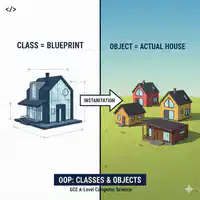
OOP 1: Classes & Objects

Interactive Video
•
Computers
•
12th Grade
•
Practice Problem
•
Hard

Benjamin Simpson-Court
FREE Resource
6 questions
Show all answers
1.
OPEN ENDED QUESTION
3 mins • 1 pt
These "really useful names" are an example of what?
Evaluate responses using AI:
OFF
Answer explanation
Names of variables, fucntions and procedures should be related to their intent/purpose. These are what are commonly referred to as self-documenting identifiers.
2.
FILL IN THE BLANK QUESTION
1 min • 1 pt
Variables defined inside a class, like Name and Breed, are known as properties or __________. They define the data an object will hold.
Answer explanation
In OOP, attributes are variables that define an object's state and characteristics, holding values that are specific to each instance of a class. They are the properties that represent what an object is or has, such as a car's color or a person's name.
State: Attributes define the current state of an object.
Characteristics: They represent the features or characteristics of an object.
Instance-specific: Each object can have different values for the same attribute (e.g., one car's color might be "red," another's "blue").
Examples: For a Car class, attributes could be color, make, year, or number_of_doors.
3.
MULTIPLE CHOICE QUESTION
30 sec • 1 pt
The line Dim C1 As New Cat does two things. What is the second, most important part?
It declares a variable called C1
It instantiates (creates) a new object from the Cat class in memory
It sets all the properties of the Cat to default values
It runs all the methods inside the Cat class
Answer explanation

The line Dim C1 As New Cat does two things: it declares a variable named C1 that can hold a Cat object, and it instantiates a new object of the Cat class, assigning it to the C1 variable.
1. Declaration
Dim C1 As Cat declares a variable named C1.
The As Cat part specifies that this variable is of the Cat type, meaning it is designed to hold a reference to an object from the Cat class.
2. Instantiation
New Cat creates a new instance (an object) of the Cat class in memory. This is often done by calling a constructor method, which initializes the object's state.
The New keyword performs this object creation and initialization process.
The Dim C1 part then assigns the memory address of this newly created Cat object to the variable C1.
4.
OPEN ENDED QUESTION
3 mins • 3 pts
The lecturer is about to create a second cat object (C2).
In your own words, explain what you think will happen to the Name property of the first cat object (C1) when he sets the name for C2?
Evaluate responses using AI:
OFF
5.
FILL IN THE BLANK QUESTION
1 min • 1 pt
The process of "releasing the memory" that an object was using is often handled automatically by a system called the ________ _________.
Answer explanation
The CLR uses a garbage collection memory management system. In this system, sometimes memory is used by objects that are no longer needed. This state is temporary; the garbage collector releases this memory based on its performance and resource usage heuristics.
Source:
6.
MULTIPLE CHOICE QUESTION
30 sec • Ungraded
How confident are you with the difference between a Class and an Object?
How confident are you with the difference between a Class and an Object?
Very confident (I could explain it to someone else).
Confident (I understand the idea).
Not very confident (I'm a bit confused).
Not confident at all (I'm lost).
Answer explanation
Follow-Up Actions: What Next?
Thank you for your feedback. Please find your recommended next step below, to be completed after class.
A. If you answered: "Very Confident"
Challenge Task: You have a solid grasp of the basics. Your task is to apply this knowledge.
Action: Before the next lesson, design a new class for a different real-world object (e.g., a Car, a Student, or a BankAccount).
On paper or in a document, list:
The Class Name.
At least four Properties (attributes) it should have.
At least two Methods (behaviours) it should be able to perform.
B. If you answered: "Confident"
Consolidation Task: You understand the core idea, but it is crucial to secure the new terminology.
Action: Review your notes from today's video. Create a precise definition table in your notes for these four key terms:
Class
Object
Property
Method
Self-Test: Look at the Visual Basic code from the video and try to label one example of each term.
C. If you answered: "Not Very Confident"
Guided Review Task: The concept can be tricky at first. Let's try a different perspective.
Action: Find a different (short) video or web page that explains "Classes vs. Objects." A common alternative analogy is the "cookie cutter and the cookie."
Write down, in your own words, two different analogies that explain the concept (e.g., the video's "blueprint vs. house" and one new one you have found).
D. If you answered: "Not Confident at All"
Intervention Task: Thank you for your honesty. This is a fundamental concept, and it is vital we get it right before moving on.
Action: Please send me a quick, private message on Google Classroom or via email before the end of today.
Just write "OOP support," and I will send you a different set of starter resources. We can then arrange a 1-to-1 chat to go through it together at a pace that works for you.
Access all questions and much more by creating a free account
Create resources
Host any resource
Get auto-graded reports

Continue with Google

Continue with Email

Continue with Classlink

Continue with Clever
or continue with

Microsoft
%20(1).png)
Apple

Others
Already have an account?
Popular Resources on Wayground

5 questions
This is not a...winter edition (Drawing game)

Quiz
•
1st - 5th Grade
25 questions
Multiplication Facts
Quiz
•
5th Grade
10 questions
Identify Iconic Christmas Movie Scenes
Interactive video
•
6th - 10th Grade
20 questions
Christmas Trivia
Quiz
•
6th - 8th Grade
18 questions
Kids Christmas Trivia
Quiz
•
KG - 5th Grade
11 questions
How well do you know your Christmas Characters?

Lesson
•
3rd Grade
14 questions
Christmas Trivia
Quiz
•
5th Grade
20 questions
How the Grinch Stole Christmas
Quiz
•
5th Grade
Discover more resources for Computers
26 questions
Christmas Movie Trivia
Lesson
•
8th Grade - Professio...
15 questions
Christmas Song Emoji Pictionary
Quiz
•
7th - 12th Grade
20 questions
Christmas Movies
Quiz
•
1st - 12th Grade
55 questions
CHS Holiday Trivia
Quiz
•
12th Grade
20 questions
Christmas Movie Trivia
Quiz
•
9th - 12th Grade
29 questions
christmas facts
Lesson
•
5th - 12th Grade
20 questions
Christmas Trivia
Quiz
•
5th - 12th Grade
20 questions
Stages of Meiosis
Quiz
•
9th - 12th Grade