
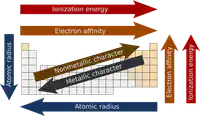
Periodic Trends

Interactive Video
•
Chemistry
•
10th Grade
•
Practice Problem
•
Easy

Jennifer Kacir
Used 1+ times
FREE Resource
8 questions
Show all answers
1.
MULTIPLE CHOICE QUESTION
30 sec • 1 pt
What is a "trend" in the context of the periodic table?
A repeating pattern of properties.
A random distribution of elements.
The physical state of an element.
The atomic mass of an element.
2.
MULTIPLE CHOICE QUESTION
30 sec • 1 pt
What happens to the atomic radius as you move down a group in the periodic table?
It decreases due to increased nuclear charge.
It increases due to the addition of more electron shells.
It remains constant.
It fluctuates unpredictably.
3.
MULTIPLE CHOICE QUESTION
30 sec • 1 pt
Why does the atomic radius generally decrease as you move from left to right across a period in the periodic table?
The number of electron shells increases.
The nuclear charge increases, pulling electrons closer to the nucleus.
The number of valence electrons decreases.
Shielding effect becomes more prominent.
4.
MULTIPLE CHOICE QUESTION
30 sec • 1 pt
What is the relationship between an atom's size and its ionization energy?
Larger atoms have higher ionization energy.
Smaller atoms have lower ionization energy.
Smaller atoms have higher ionization energy.
Atomic size has no effect on ionization energy.
5.
MULTIPLE CHOICE QUESTION
30 sec • 1 pt
How does ionization energy generally change as you move from left to right across a period in the periodic table?
It decreases.
It increases.
It remains constant.
It first decreases then increases.
6.
MULTIPLE CHOICE QUESTION
30 sec • 1 pt
What happens to the ionization energy of elements as you move down a group in the periodic table?
It increases.
It decreases.
It remains constant.
It first increases then decreases.
7.
MULTIPLE CHOICE QUESTION
30 sec • 1 pt
What does electronegativity measure?
The energy required to remove an electron from an atom.
The size of an atom's nucleus.
An atom's attraction to electrons.
The number of valence electrons in an atom.
Access all questions and much more by creating a free account
Create resources
Host any resource
Get auto-graded reports

Continue with Google

Continue with Email

Continue with Classlink

Continue with Clever
or continue with

Microsoft
%20(1).png)
Apple

Others
Already have an account?

