
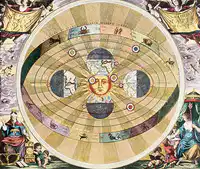
Planetary Motion and Historical Discoveries

Interactive Video
•
Science
•
11th Grade
•
Practice Problem
•
Hard

Simone Huey
FREE Resource
9 questions
Show all answers
1.
MULTIPLE CHOICE QUESTION
30 sec • 1 pt
What event led to Tycho Brahe losing part of his nose?
A hunting accident
A duel over a mathematical dispute
A laboratory explosion
A severe illness
2.
MULTIPLE CHOICE QUESTION
30 sec • 1 pt
What were the names of the two main structures Tycho Brahe built on his research island of Hven?
Uraniborg and Stjerniborg
Castle of the Heavens and Castle of the Stars
Hvenborg and Starcastle
Observatory Alpha and Observatory Beta
3.
MULTIPLE CHOICE QUESTION
30 sec • 1 pt
Which model of the cosmos did Tycho Brahe propose?
Heliocentric, where all planets orbit the Sun.
Geocentric, where all celestial bodies orbit the Earth.
Geo-heliocentric, where the Sun orbits the Earth, and other planets orbit the Sun.
Ptolemaic, an Earth-centered model with complex epicycles.
4.
MULTIPLE CHOICE QUESTION
30 sec • 1 pt
What was the major implication of Tycho Brahe's observation of the "Nova Stella" in 1572?
It proved the Earth was not the center of the universe.
It demonstrated that telescopes were essential for astronomical observations.
It challenged the long-held belief that the heavens were perfect and unchanging.
It confirmed the existence of comets as celestial bodies.
5.
MULTIPLE CHOICE QUESTION
30 sec • Ungraded
Are you enjoying the video lesson?
Yes
No
6.
MULTIPLE CHOICE QUESTION
30 sec • 1 pt
What does Kepler's First Law of Planetary Motion state about planetary orbits?
Planets orbit the Sun in perfect circles.
Planets orbit the Sun in ellipses, with the Sun at the center.
Planets orbit the Sun in ellipses, with the Sun at one of the two foci.
Planets orbit the Sun at a constant speed.
7.
MULTIPLE CHOICE QUESTION
30 sec • 1 pt
Which statement accurately describes a planet's speed in its elliptical orbit around the Sun?
A planet travels at a constant speed throughout its orbit.
A planet travels faster when it is closer to the Sun.
A planet travels slower when it is closer to the Sun.
A planet's speed is only constant when its orbit is perfectly circular.
Access all questions and much more by creating a free account
Create resources
Host any resource
Get auto-graded reports

Continue with Google

Continue with Email

Continue with Microsoft
or continue with

%20(1).png)
Apple

Others
By signing up, you agree to our Terms of Service & Privacy Policy
Already have an account?

