
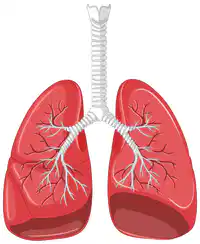
Respiratory System 1

Interactive Video
•
Science
•
7th Grade
•
Practice Problem
•
Hard

Jennifer Hand
FREE Resource
9 questions
Show all answers
1.
MULTIPLE CHOICE QUESTION
30 sec • 1 pt
How did the earliest, simplest forms of life, like bacteria, obtain the oxygen they needed?
Through a complex circulatory system.
By actively pumping water through specialized organs.
Directly from the water through their membranes via diffusion.
By consuming other organisms that had already processed oxygen.
2.
MULTIPLE CHOICE QUESTION
30 sec • 1 pt
What environmental changes led to the evolution of lungs in lobe-finned fish?
Increased predation in deep ocean waters.
Earth getting warmer, seas shallower, and lower oxygen concentrations in surface water.
A sudden increase in atmospheric carbon dioxide levels.
The emergence of new land-based food sources.
3.
MULTIPLE CHOICE QUESTION
30 sec • 1 pt
Why is simple diffusion alone insufficient for oxygen transport in large, complex organisms like humans?
Simple diffusion requires too much energy.
The concentration gradient is not strong enough in large organisms.
Oxygen molecules would take too long to diffuse across the necessary distances, leading to cell death.
Large organisms have too many cells, making diffusion impractical.
4.
MULTIPLE CHOICE QUESTION
30 sec • Ungraded
Are you enjoying the video lesson?
Yes
No
5.
MULTIPLE CHOICE QUESTION
30 sec • 1 pt
How do the respiratory and circulatory systems work together to efficiently deliver oxygen throughout the body?
The respiratory system uses bulk flow to move oxygen into the lungs, and the circulatory system uses simple diffusion to distribute it to cells.
Both systems rely solely on simple diffusion for oxygen transport.
The circulatory system uses bulk flow to transport oxygen-rich blood, and simple diffusion moves oxygen from lung cells into the blood.
The respiratory system actively transports oxygen, while the circulatory system passively carries it.
6.
MULTIPLE CHOICE QUESTION
30 sec • 1 pt
What happens to the diaphragm and rib cage when you breathe in?
The diaphragm relaxes and the ribs move down.
The diaphragm contracts and flattens, and the ribs lift up and out.
The diaphragm contracts and pushes up, and the ribs move down.
The diaphragm relaxes and flattens, and the ribs lift up and out.
7.
MULTIPLE CHOICE QUESTION
30 sec • 1 pt
Besides filtering particles, what is another crucial function of the nose and sinuses in breathing?
They produce hormones that regulate breathing rate.
They cool and dry incoming air to protect lung cells.
They warm and moisten incoming air to prevent lung cells from drying out.
They act as a secondary site for gas exchange.
Access all questions and much more by creating a free account
Create resources
Host any resource
Get auto-graded reports

Continue with Google

Continue with Email

Continue with Microsoft
or continue with

%20(1).png)
Apple

Others
Already have an account?


