Free Printable Drawing Lines Worksheets for Year 1
Year 1 drawing lines worksheets from Wayground help young learners develop essential fine motor skills and pre-writing abilities through engaging printable activities with answer keys for effective practice.
Explore printable Drawing Lines worksheets for Year 1
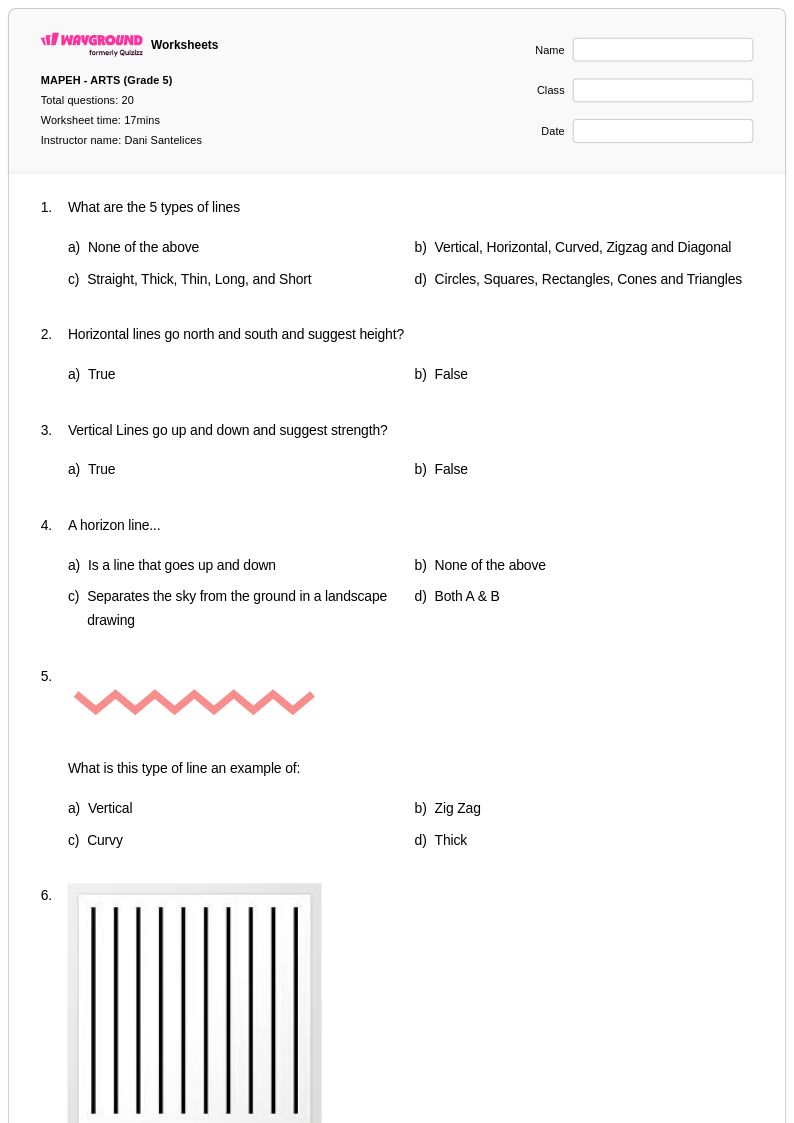
Drawing lines worksheets for Year 1 students through Wayground (formerly Quizizz) provide essential foundational practice for developing fine motor skills and pre-writing abilities. These comprehensive printables focus on helping young learners master controlled hand movements through tracing straight lines, curved lines, zigzag patterns, and various directional strokes that serve as building blocks for letter formation. Each worksheet includes structured practice problems that progress from simple horizontal and vertical lines to more complex diagonal and wavy patterns, allowing students to build confidence and precision gradually. Teachers can access free pdf versions complete with answer keys to monitor student progress and identify areas where additional support may be needed during this critical early writing development phase.
Wayground (formerly Quizizz) empowers educators with millions of teacher-created drawing lines resources specifically designed for Year 1 classrooms, featuring robust search and filtering capabilities that help locate materials aligned with specific learning standards and developmental milestones. The platform's differentiation tools enable teachers to customize worksheets based on individual student needs, offering both printable pdf formats for traditional classroom use and digital versions for interactive learning experiences. These flexible resources support comprehensive lesson planning by providing options for initial skill introduction, targeted remediation for struggling learners, and enrichment activities for advanced students, ensuring that all first-grade students receive appropriate practice opportunities to strengthen their fine motor control and prepare for formal handwriting instruction.
FAQs
How do I teach line drawing to young learners before they start writing letters?
Introduce line drawing in a structured sequence that moves from simple to complex: start with horizontal and vertical straight lines, then progress to diagonal lines, curves, and zigzags. This progression builds the specific muscle memory and pencil control that letter formation demands. Using verbal cues like 'top to bottom' or 'left to right' alongside physical practice helps students internalize directionality before they encounter actual letters.
What types of line drawing exercises best prepare students for handwriting?
Exercises that mirror the actual strokes used in letter formation are most effective — these include straight lines, curved lines, loops, diagonal strokes, and zigzag patterns. Tracing exercises are a strong starting point because they reduce the motor planning demand, allowing students to focus on grip and pressure. As control improves, students should transition to copying lines independently without a guide underneath.
What mistakes do young learners commonly make when practicing line drawing?
The most common errors are inconsistent pencil pressure, gripping the pencil too tightly, and losing directionality mid-stroke. Students often lift the pencil prematurely when drawing continuous curves or zigzags, breaking the line into segments rather than producing a fluid motion. Watching for these patterns early allows teachers to address grip and stroke technique before these habits carry over into letter writing.
How can I use drawing lines worksheets to support students with fine motor delays?
For students with fine motor delays, start with larger-scale tracing tasks and thicker writing tools to reduce the precision demand before moving to standard pencil-and-paper exercises. Wayground's digital worksheet format supports accommodations such as read aloud and adjustable font sizes and themes through reading mode, which can reduce visual fatigue for students who struggle with standard printed formats. Extended time can also be configured per student so learners work at a pace appropriate to their developmental stage without affecting the rest of the class.
How do I use Wayground's drawing lines worksheets in my classroom?
Wayground's drawing lines worksheets are available as printable PDFs for traditional pencil-and-paper practice and in digital formats for technology-integrated instruction, giving teachers flexibility across different classroom setups. You can also host the worksheets as a live quiz on Wayground, which is useful for whole-class warm-ups or guided sessions where you want to monitor student progress in real time. Each worksheet includes answer keys and visual guides that support both independent student work and direct instruction.
How often should early learners practice drawing lines to build handwriting readiness?
Short, frequent sessions of five to ten minutes are more effective than infrequent longer ones because fine motor skill development depends on repeated, consistent practice to build muscle memory. Daily exposure to varied line types — straight, curved, diagonal, and patterned — accelerates the hand-eye coordination and pencil control that underpin successful letter formation. Embedding brief line drawing warm-ups at the start of writing instruction is a practical way to maintain this regularity.