Free Printable Elements and Compounds Worksheets for Year 4
Year 4 chemistry worksheets on elements and compounds help students practice distinguishing between pure substances and mixtures through engaging printables, free PDF activities, and practice problems with complete answer keys.
Explore printable Elements and Compounds worksheets for Year 4
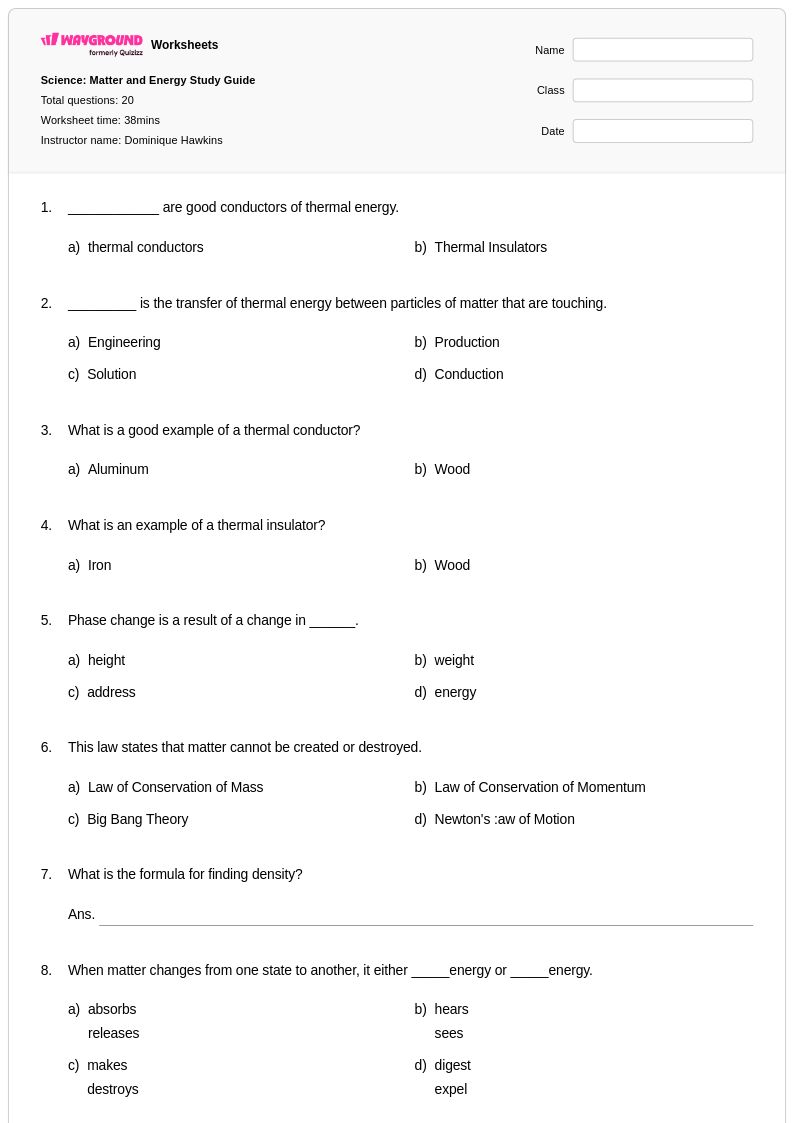
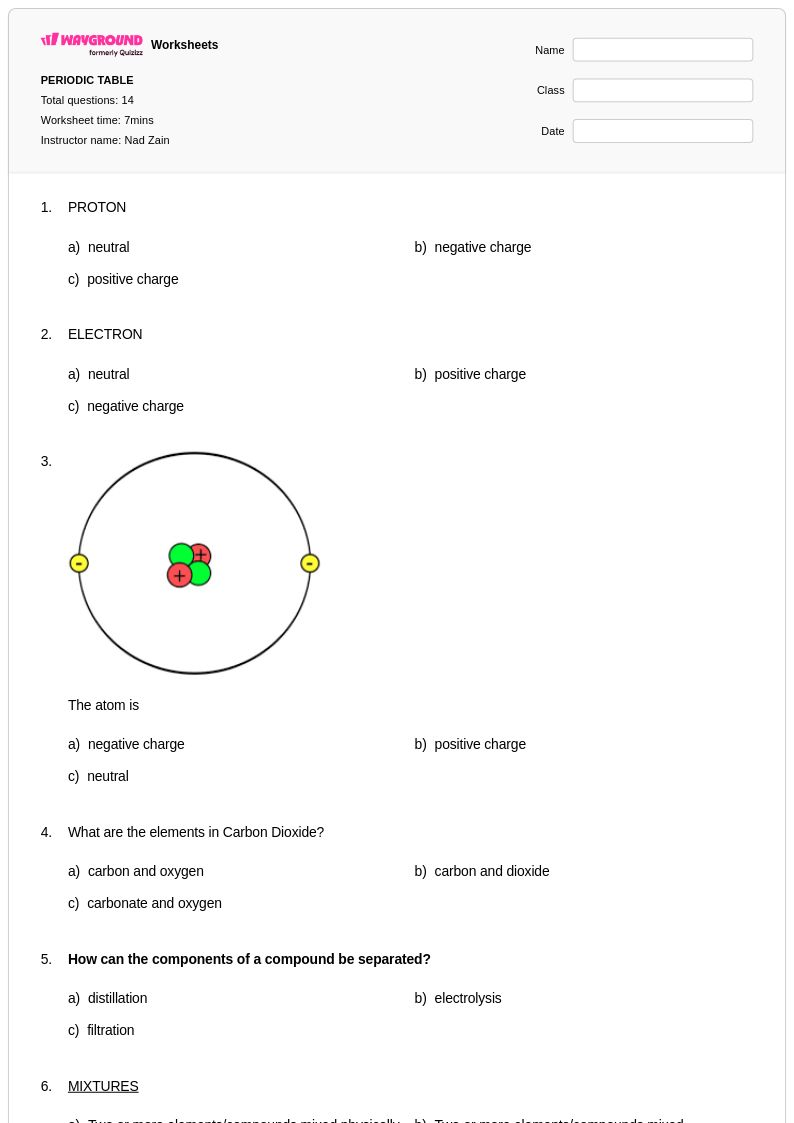
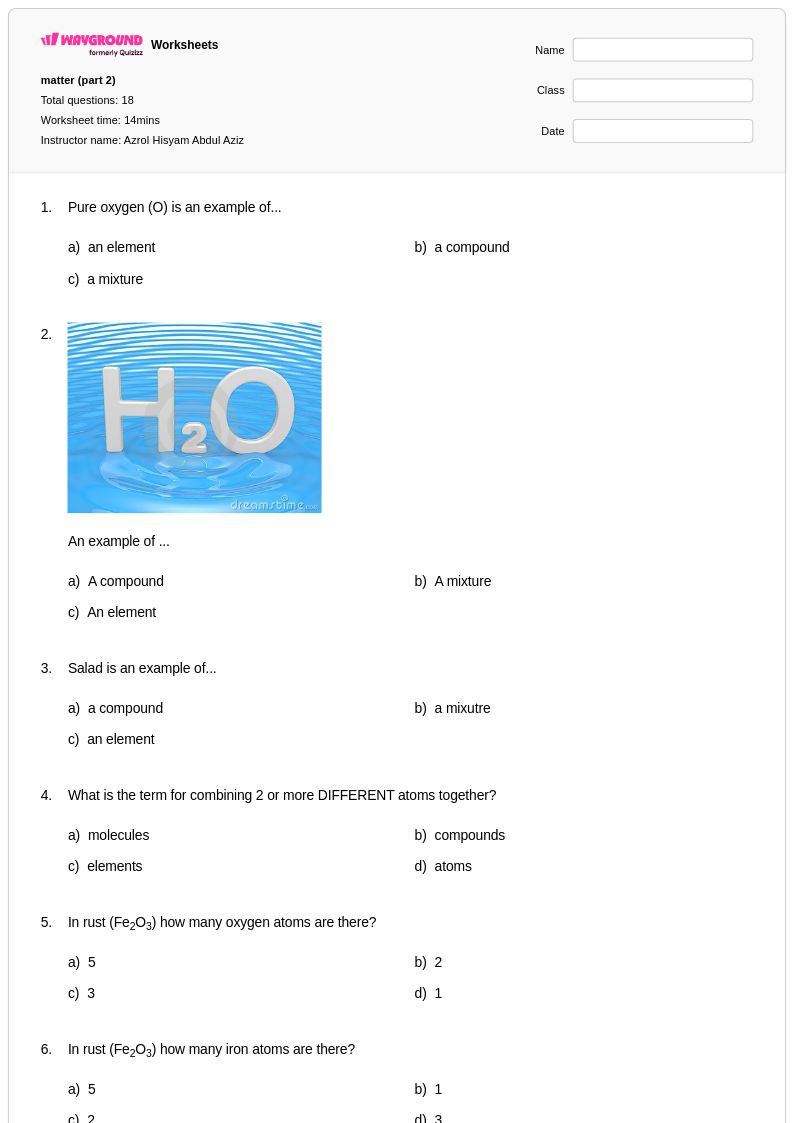
Year 4 elements and compounds worksheets available through Wayground (formerly Quizizz) provide young scientists with essential foundational knowledge about the building blocks of matter. These carefully designed educational resources help students distinguish between pure elements and compounds while developing critical thinking skills about how different substances combine to form new materials. Each worksheet collection includes comprehensive answer keys and detailed explanations that guide fourth-grade learners through hands-on practice problems involving common elements like oxygen and carbon, as well as familiar compounds such as water and salt. The free printable materials strengthen observation skills, scientific vocabulary, and basic classification abilities that form the cornerstone of chemistry education at the elementary level.
Wayground (formerly Quizizz) empowers educators with millions of teacher-created resources specifically focused on elements and compounds instruction for Year 4 students. The platform's robust search and filtering capabilities allow teachers to quickly locate standards-aligned worksheets that match their specific curriculum requirements and student ability levels. Advanced differentiation tools enable instructors to customize practice problems and modify content complexity, ensuring both struggling learners and advanced students receive appropriate challenges. These versatile materials are available in both printable pdf format and interactive digital versions, giving teachers maximum flexibility for classroom instruction, homework assignments, remediation sessions, and enrichment activities that deepen students' understanding of fundamental chemical concepts.
FAQs
How do I teach the difference between elements and compounds to my students?
Start by grounding students in the definition of a pure substance, then use the periodic table to show that elements are the simplest form of matter, made of one type of atom. Introduce compounds as substances formed when two or more elements chemically combine in fixed ratios, which distinguishes them from mixtures. Visual models of molecular structures and hands-on classification activities help students internalize the distinction before moving to chemical formulas and bonding.
What exercises help students practice identifying elements and compounds?
Effective practice includes classifying a list of substances as elements, compounds, or mixtures using their chemical formulas, and writing or interpreting formulas like H₂O or NaCl to identify component elements. Students also benefit from exercises where they match element symbols to their names on the periodic table and predict compound formation based on valence electrons. Ranging from basic element identification to complex compound analysis builds confidence incrementally.
What mistakes do students commonly make when learning about elements and compounds?
A frequent misconception is that mixtures and compounds are interchangeable, when in fact compounds are chemically bonded and have fixed ratios, while mixtures are physically combined and variable. Students also commonly confuse element symbols, particularly those derived from Latin names such as Fe for iron or Na for sodium. Another common error is assuming that all substances made of two or more atoms are compounds, failing to account for diatomic elements like O₂ or N₂.
How do I help students understand ionic versus covalent bonding in compounds?
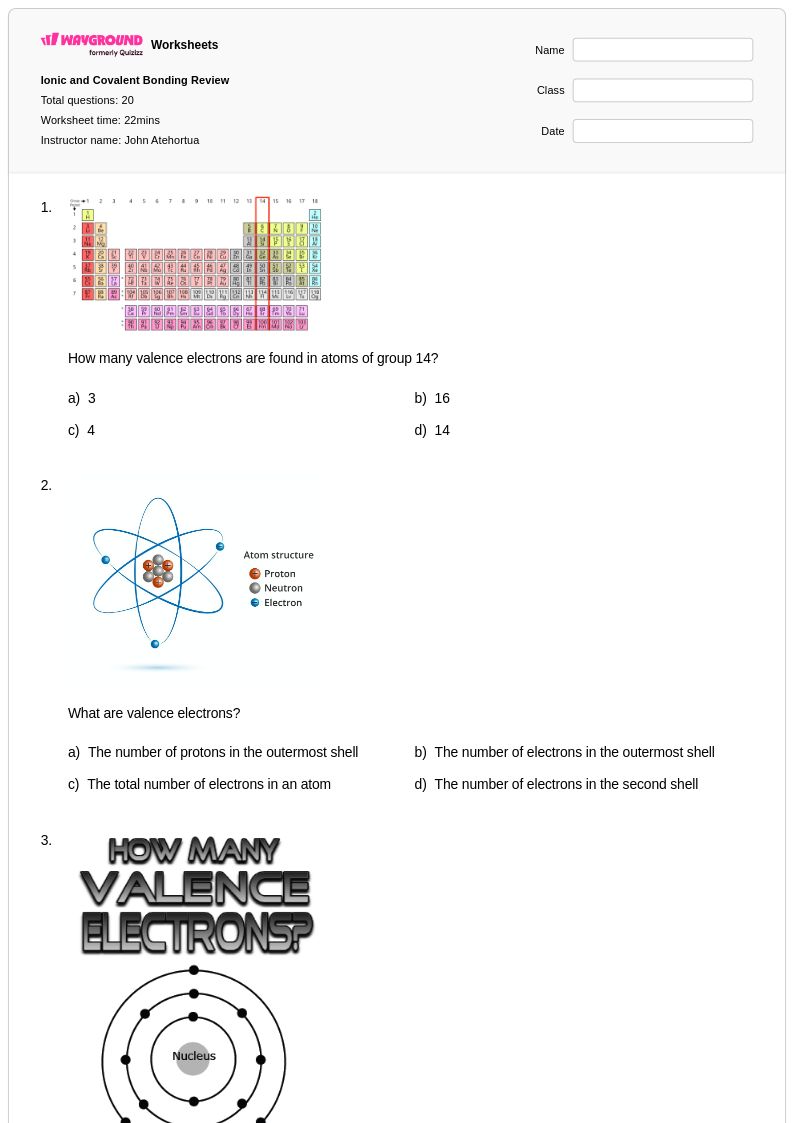
Ionic bonding occurs between metals and nonmetals through electron transfer, producing charged ions that attract each other, while covalent bonding involves nonmetals sharing electrons. Use electron configuration diagrams to show why certain atoms give or take electrons versus share them. Practice problems that ask students to predict bond type based on periodic table position reinforce this distinction and prepare them to write accurate chemical formulas.
How can I use elements and compounds worksheets in my classroom?
Elements and compounds worksheets on Wayground are available as printable PDFs for traditional classroom use and in digital formats for technology-integrated learning environments, giving teachers flexibility depending on their setup. Teachers can also host worksheets as a quiz directly on Wayground, enabling real-time student responses and automatic grading. Each worksheet includes a complete answer key, supporting independent practice, self-assessment, or guided review sessions.
How do I differentiate elements and compounds instruction for students at different skill levels?
For struggling students, begin with basic element identification and symbol-to-name matching before introducing compound formation. Advanced learners can move into predicting compound formulas from electron configurations and analyzing bonding type. On Wayground, teachers can apply accommodations such as read aloud, reduced answer choices, and extended time to individual students, allowing the same worksheet to serve a mixed-ability class without singling out any student.