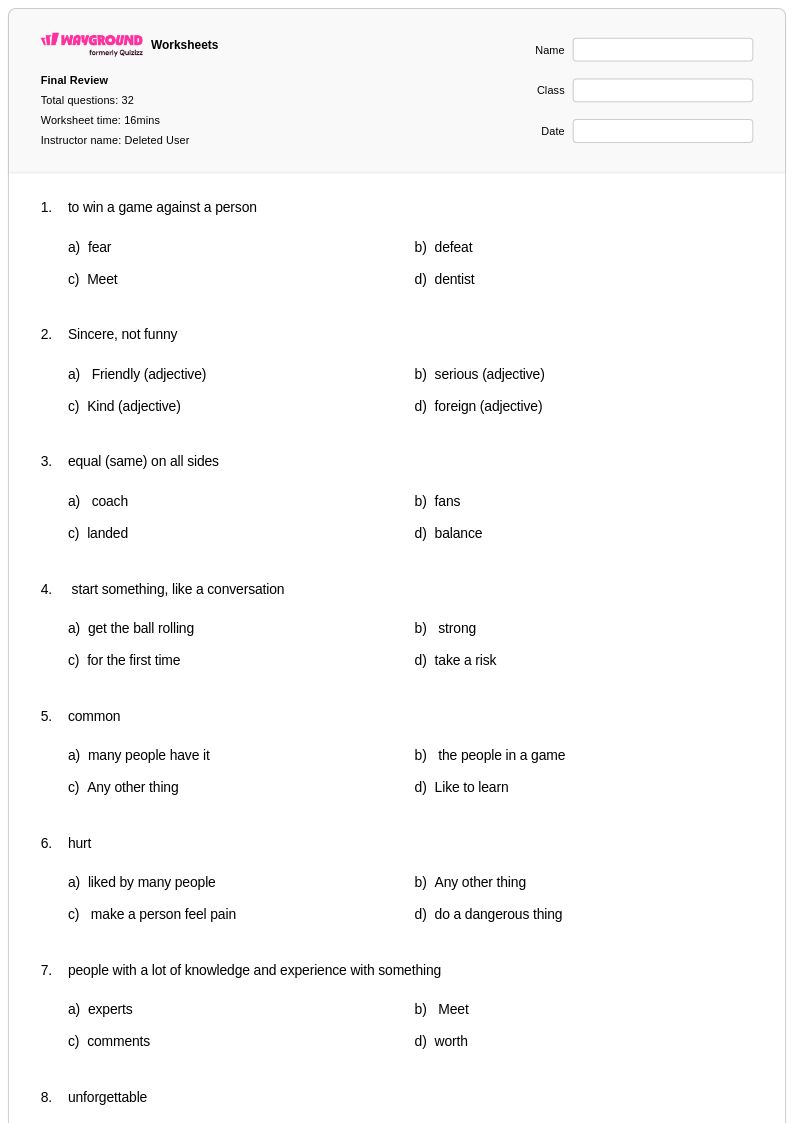
Enhance Year 2 students' lettering skills with Wayground's comprehensive collection of free handwriting worksheets, featuring engaging printables, practice problems, and answer keys in convenient PDF format.
Year 2 lettering worksheets available through Wayground (formerly Quizizz) provide essential foundational practice for young students developing proper letter formation and handwriting skills. These comprehensive printables focus on teaching correct letter shapes, sizing, and spacing while reinforcing the muscle memory needed for fluent writing. Each worksheet collection includes systematic practice problems that guide students through proper stroke order and letter positioning, with answer keys available to support both independent practice and teacher-guided instruction. The free pdf resources cover uppercase and lowercase letter formation, helping second-grade students master the precise motor skills required for legible handwriting while building confidence in their writing abilities.
Wayground (formerly Quizizz) empowers teachers with millions of educator-created lettering resources specifically designed for Year 2 handwriting instruction. The platform's robust search and filtering capabilities allow teachers to quickly locate worksheets aligned with handwriting standards and differentiated for various skill levels within their classroom. Teachers can customize these printable and digital materials to address individual student needs, whether providing additional practice for struggling learners or offering enrichment activities for advanced writers. The extensive collection supports comprehensive lesson planning by offering resources for daily handwriting practice, remediation sessions, and skill-building activities, all available in flexible formats that accommodate both traditional paper-based instruction and modern digital learning environments.
FAQs
How do I teach proper letter formation to students who are just starting out?
Begin with the foundational strokes common to multiple letters — vertical lines, horizontal lines, curves, and diagonal lines — before introducing individual letters. Group letters by shared stroke patterns (for example, c, o, d, g, and q all begin with the same curved stroke) so students build muscle memory efficiently. Consistent practice with structured tracing activities, followed by independent writing without guides, reinforces correct formation before bad habits solidify.
What exercises help students practice consistent letter formation and spacing?
Structured tracing exercises that progress to independent writing are the most effective way to build consistent letter formation. Students benefit from exercises that isolate individual letters first, then move to letter combinations and words, so they apply formation habits in context. Spacing practice — using finger spaces between words or baseline-to-midline guides — should be integrated from early stages so consistency becomes automatic rather than a separate skill to learn.
What are the most common mistakes students make with lettering?
The most frequent errors include inconsistent letter size (mixing capital-height and lowercase letters within a word), incorrect starting points that produce reversed or malformed strokes, and uneven spacing between letters and words. Students also commonly struggle with letter reversals, particularly b/d and p/q, due to incomplete visual-spatial awareness. Identifying these patterns early through reviewed writing samples allows teachers to target intervention before errors become habitual.
How do I support students with fine motor difficulties during lettering practice?
For students with fine motor challenges, start with larger writing surfaces and thicker writing tools to reduce the precision demand before moving to standard paper. Incorporate warm-up activities like finger tracing, sand writing, or sky writing to build motor pathways without pen pressure. On Wayground, the Read Aloud feature can support students who need auditory reinforcement of instructions, and extended time accommodations can be set per student so practice sessions remain low-pressure and productive.
How do I use Wayground's lettering worksheets in my classroom?
Wayground's lettering worksheets are available as printable PDFs for traditional paper-and-pencil practice and in digital formats for technology-integrated classrooms, giving teachers flexibility in how they assign and collect work. Teachers can also host worksheets as a quiz directly on Wayground for an interactive experience. The platform includes robust search and filtering tools so you can quickly locate worksheets aligned to specific learning objectives, whether you need introductory tracing activities or more advanced independent writing practice.
How do I differentiate lettering instruction for students at different skill levels?
Differentiation in lettering instruction means offering varying levels of support within the same activity — some students may need fully guided tracing with directional arrows, while others are ready for blank lines with only a reference model. Wayground allows teachers to customize worksheets to meet diverse needs, whether for initial instruction, targeted remediation, or enrichment. Accommodations such as reduced answer choices and adjustable reading modes can be applied to individual students without signaling differences to the rest of the class.