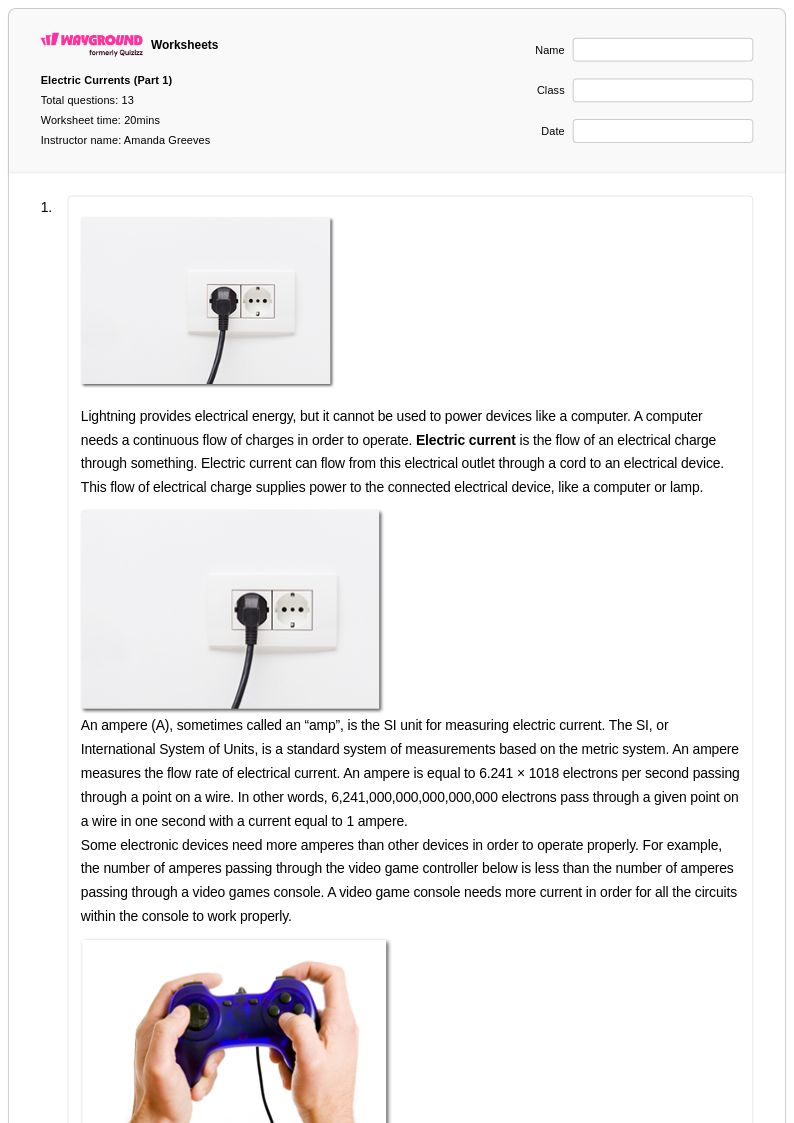
Year 8 SI System worksheets from Wayground offer free printables and practice problems that help students master the International System of Units, complete with answer keys and comprehensive PDF resources for effective learning.
The SI System worksheets available through Wayground (formerly Quizizz) provide Year 8 students with comprehensive practice in mastering the International System of Units, the foundation of modern scientific measurement. These expertly designed resources strengthen critical skills including unit conversion between metric prefixes, understanding base units like meters, kilograms, and seconds, and applying proper scientific notation when working with very large or small quantities. Students develop proficiency in recognizing the relationships between units such as converting millimeters to kilometers or grams to kilograms, while building confidence with derived units like velocity and density. Each worksheet includes detailed answer keys that support independent learning and self-assessment, with free printables offering flexible practice problems that reinforce the systematic nature of metric measurement essential for scientific literacy.
Wayground (formerly Quizizz) empowers educators with an extensive collection of millions of teacher-created SI System resources that streamline lesson planning and differentiated instruction for Year 8 science classrooms. The platform's robust search and filtering capabilities allow teachers to quickly locate worksheets aligned with specific curriculum standards, whether focusing on fundamental metric conversions or more advanced applications of scientific measurement. Customization tools enable educators to modify existing materials or create targeted practice sets that address individual student needs, supporting both remediation for struggling learners and enrichment for advanced students. Available in both printable pdf formats for traditional classroom use and interactive digital versions for technology-enhanced learning, these resources facilitate seamless skill practice across diverse teaching environments while ensuring students develop the measurement competencies required for success in physical science, chemistry, and physics.
FAQs
How do I teach the SI system to students who have never used metric units before?
Start by anchoring each base unit to a concrete, relatable reference — for example, a meter is roughly the distance from the floor to a doorknob, and a kilogram is about the mass of a liter of water. Introduce the seven base units one at a time before layering in derived units and prefixes. Connecting abstract units to physical objects first significantly reduces cognitive load and helps students build intuition for scale before they attempt any conversions.
What exercises help students practice SI unit conversions effectively?
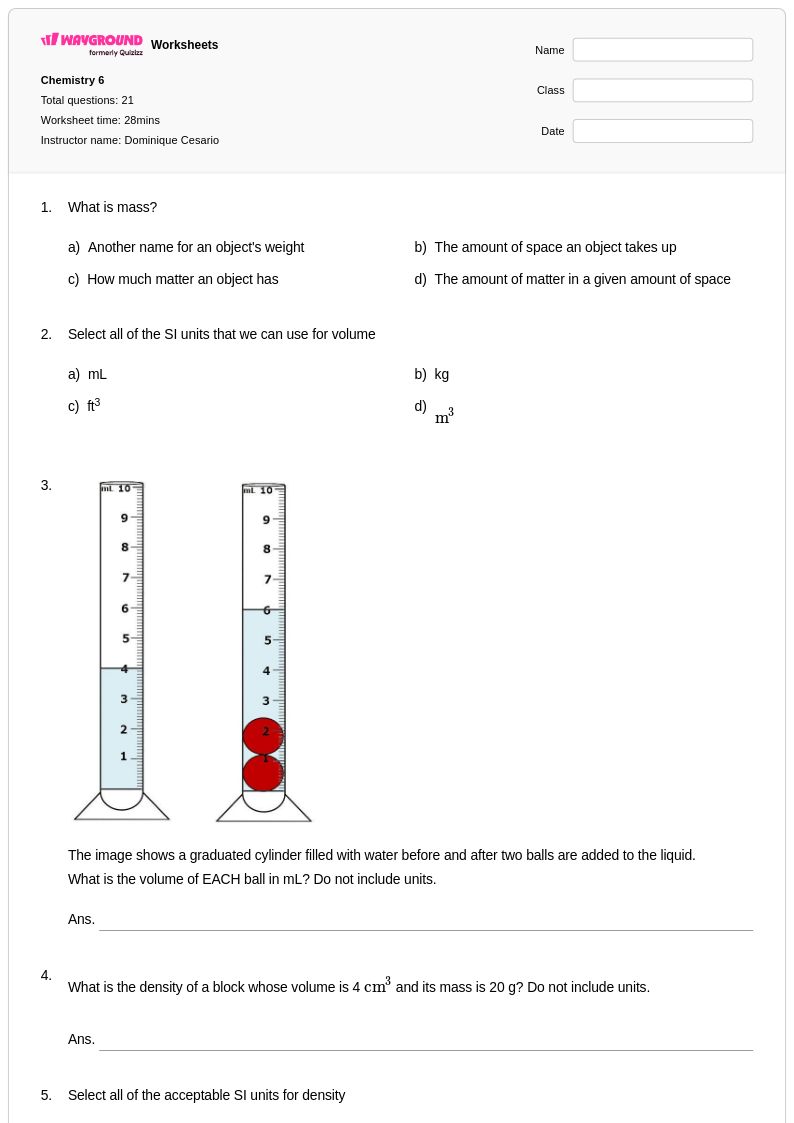
Dimensional analysis practice is the most reliable method for building conversion fluency — students write conversion factors as fractions and cancel units systematically, which makes errors visible and correctable. Structured worksheets that progress from single-step conversions (e.g., kilometers to meters) to multi-step problems (e.g., milligrams per liter to kilograms per cubic meter) build skill incrementally. Including scientific notation in conversion problems also reinforces two critical skills simultaneously, which is especially useful in middle and high school science contexts.
What mistakes do students commonly make when working with metric prefixes?
The most common error is moving the decimal point in the wrong direction — students frequently confuse whether to multiply or divide when converting between prefixes like milli, centi, and kilo. A related mistake is conflating the prefix meaning with the conversion factor, such as assuming 'milli' means divide by 10 rather than divide by 1,000. Another frequent error is misapplying prefixes in compound units, such as incorrectly converting square centimeters to square meters by a factor of 100 rather than 10,000.
How do I use SI system worksheets to support students at different skill levels?
Differentiate by assigning problems that match each student's current level of mastery — use basic unit identification and single-step conversions for students who need remediation, and reserve multi-step dimensional analysis and scientific notation problems for advanced learners. On Wayground, teachers can apply individual accommodations such as read aloud support, extended time, and reduced answer choices for students who need additional scaffolding, without other students being aware of the adjustments. This makes it practical to run differentiated SI system practice within a single class session.
How can I use Wayground's SI system worksheets in my classroom?
Wayground's SI system worksheets are available as printable PDFs for traditional classroom use and in digital formats for technology-integrated or remote learning environments. Teachers can also host worksheets directly as a quiz on Wayground, enabling real-time student responses and instant scoring. Each worksheet includes a complete answer key, so teachers can distribute practice independently and students can self-check their work without waiting for manual grading.
Why is the SI system important for students to learn in science class?
The SI system is the internationally standardized measurement framework used in virtually all scientific research, engineering, and medicine, which means fluency with metric units is a prerequisite skill for laboratory work across every science discipline. Students who lack confidence with SI units consistently struggle with data analysis, graphing, and experimental design at the secondary and post-secondary level. Teaching SI measurement early and reinforcing it through structured practice builds the measurement literacy that underpins success in physics, chemistry, biology, and earth science.