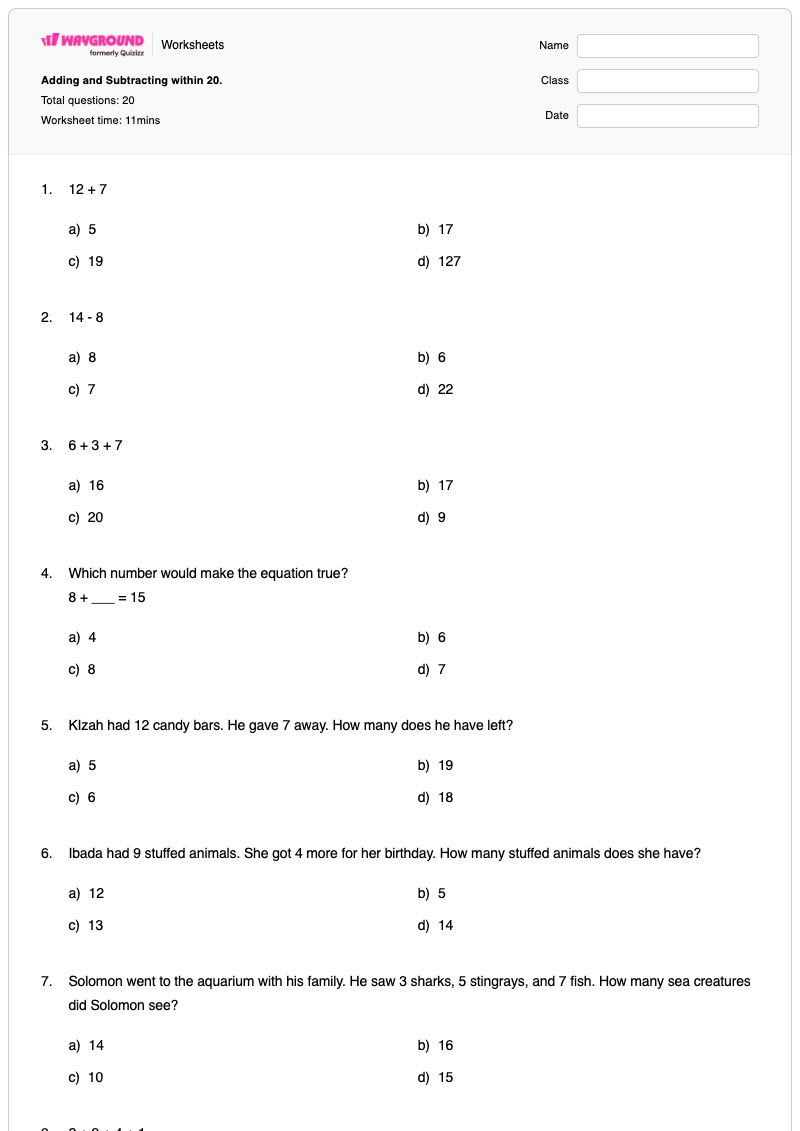
Adding and Subtracting within 20 is a mathematics worksheet for students in Grades 1–3 who are developing fluency with addition and subtraction facts and expressions. The 20 questions include 17 multiple-choice items and 3 multiple-select items covering one-step equations, missing addends, subtraction equations, sums with several addends, and short word problems involving quantities up to 20.
Students also compare expressions, identify equivalent addition and subtraction statements, and select the expression with the smallest answer. The varied format asks them to calculate accurately, interpret language such as “more,” “left,” and “in all,” and apply operations in everyday situations. Use this free printable worksheet for independent practice, classwork, review, or a quick check of foundational computation skills. It includes a complete answer key for efficient checking and feedback.
Worksheet settings
Font size
S
M
L
XL
Worksheets
Adding and Subtracting within 20.
Total questions: 20
Name
Class
Date
1.
12 + 7
a)
5
b)
17
c)
19
d)
127
2.
14 - 8
a)
8
b)
6
c)
7
d)
22
3.
6 + 3 + 7
a)
16
b)
17
c)
20
d)
9
4.
Which number would make the equation true? 8 + ___ = 15
a)
4
b)
6
c)
8
d)
7
5.
KIzah had 12 candy bars. He gave 7 away. How many does he have left?
a)
5
b)
19
c)
6
d)
18
6.
Ibada had 9 stuffed animals. She got 4 more for her birthday. How many stuffed animals does she have?
a)
12
b)
5
c)
13
d)
14
7.
Solomon went to the aquarium with his family. He saw 3 sharks, 5 stingrays, and 7 fish. How many sea creatures did Solomon see?
a)
14
b)
16
c)
10
d)
15
8.
2 + 9 + 4 + 1
a)
16
b)
14
c)
13
d)
17
9.
Peace finished 3 math problems for morning work. She finished 5 more during math class and 6 more for homework. How many math problems did she complete in all?
a)
11
b)
8
c)
14
d)
2
10.
18 -13
a)
8
b)
5
c)
15
d)
6
11.
Odancy, Baraka, and Hashim ran in a race. Baraka ran 5 miles, Odancy ran 8 miles, and Hashim ran 6 miles. What is the sum of the total number of miles ran?
a)
16
b)
17
c)
14
d)
19
12.
9+9=
a)
15
b)
16
c)
17
d)
18
13.
15-5=
a)
9
b)
10
c)
11
d)
12
14.
Check two boxes that give the same answer.
a)
7+4
b)
16-7
c)
20-9
d)
6+6
15.
Which of the following gives the smallest answer.
a)
2 less than 17
b)
3 more than 10
c)
14-5
d)
4+9
16.
Complete the equation.
17 - ? = 8 + 2
a)
5
b)
6
c)
7
d)
8
17.
Complete the equation.
? - 6 = 12
a)
6
b)
12
c)
18
d)
24
18.
Select true or false.
8 + 9 = 8 + 8 + 1
a)
True
b)
False
19.
Select true or false.
There are 4 marbles in a jar.
Juma put 7 more marbles into the jar.
There are 12 marbles now.
a)
True
b)
False
20.
Complete the pattern.
3 , 5 , ? , 9 , 11 , ? , 15 , 17
a)
6 and 12
b)
7 and 13
c)
8 and 14
d)
8 and 13
Answer Key
Adding and Subtracting within 20.
Total questions: 20
1.
c) 19
2.
b) 6
3.
a) 16
4.
d) 7
5.
a)
5
6.
c)
13
7.
d)
15
8.
a) 16
9.
c)
14
10.
b) 5
11.
d)
19
12.
d)
18
13.
b)
10
14.
a)
7+4
, c)
20-9
15.
c)
14-5
16.
c)
7
17.
c)
18
18.
a)
True
19.
b)
False
20.
b)
7 and 13
140 %
Browse by subjects
Browse by grades
Browse by format
FAQs
What does the Adding and Subtracting within 20 worksheet cover?
This Grade 1–3 mathematics worksheet builds fluency with addition and subtraction within 20 through 20 questions: 17 multiple-choice items and 3 multiple-select items. Students solve direct equations, find a missing addend such as 8 + ___ = 15, combine several addends, interpret short word problems, match equivalent expressions, and identify the smallest result.
How can I use this worksheet to teach addition and subtraction within 20?
Begin by modeling how to represent an equation or word problem with a number sentence, then solve a few direct addition and subtraction items together. Ask students to explain language cues such as “gave away,” “got more,” and “in all” before they choose an operation. Use the equivalent-expression and smallest-answer items for a follow-up discussion about comparing results rather than calculating in isolation.
What mistakes should I watch for when students complete this worksheet?
Students may reverse addition and subtraction when reading the word problems, especially by treating “gave away” as an addition situation or “got more” as subtraction. They may also omit one addend in multi-addend equations, choose the visible operation without solving it, or select only one option on the multiple-select item that requires two equivalent expressions. Check that students compare actual answers when identifying the smallest result.
How do I assign and grade this adding and subtracting worksheet?
On Wayground, assign the worksheet as a printable PDF or use it as a digital quiz. The worksheet includes a complete answer key, and printable submissions can be graded by scanning student work with the Wayground for Teachers app. The PDF option also supports classrooms that want to reduce screen time while students solve the equations and word problems on paper.
How can I differentiate this worksheet for my students?
Use the worksheet’s Advanced Settings to adjust font spacing or choose a larger font size so the equations, answer choices, and word problems are easier to read. You can also enable a dyslexia-friendly font or translate the worksheet into another language when that better supports access to the mathematical directions and story problems.
Where can I find more worksheets like this on Wayground?
Wayground offers a broad collection of free printable worksheets and practice problems across subjects, with downloadable PDFs and answer keys to support essential skills and concepts. Browse more resources at https://wayground.com/en-us/worksheets.


 Worksheets