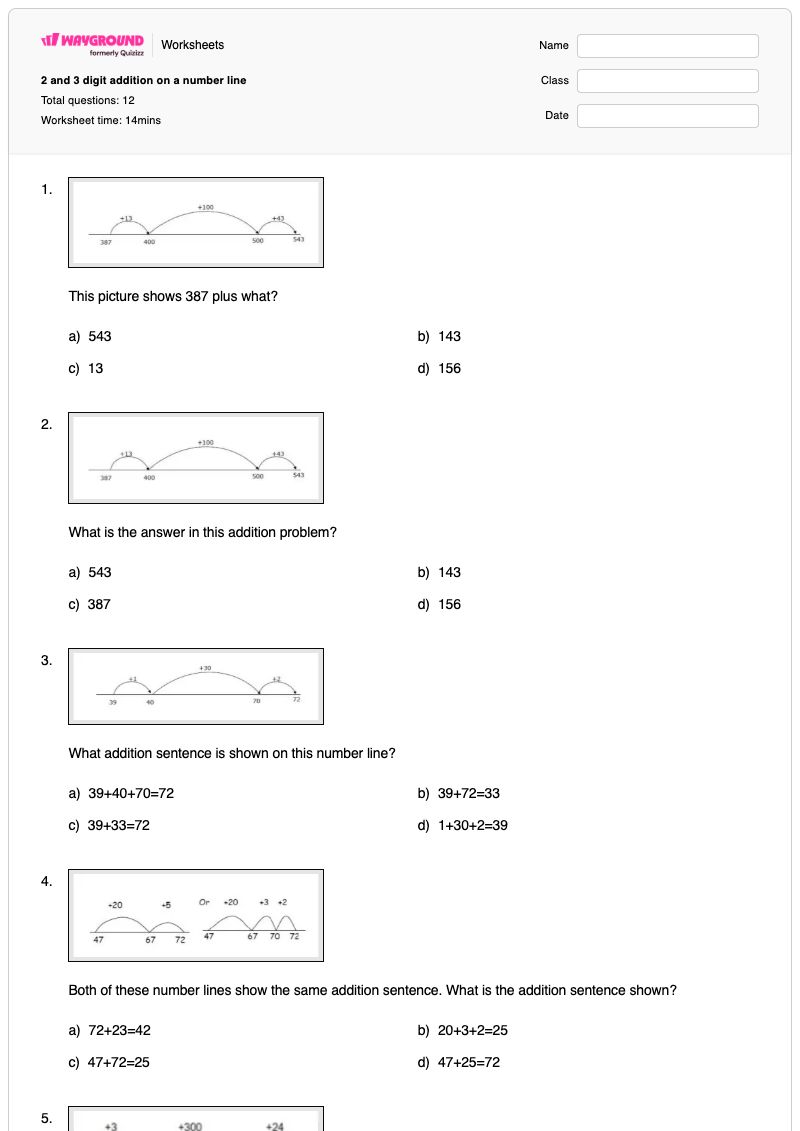
This free printable mathematics worksheet helps students in Grades 2–5 interpret and solve two- and three-digit addition using number lines, visual models, and mental-math decompositions. Across 12 items—11 multiple-choice questions and 1 fill-in-the-blank problem—students identify the addition sentence represented by a number line or picture, find an unknown addend, and choose efficient ways to break apart numbers for easier computation. The final item asks students to solve a three-digit addition problem, providing a brief check of independent accuracy.
Use the worksheet to connect visual representations with standard addition equations and place-value reasoning. Students must distinguish the starting number, the amount added, and the total, then apply strategies such as making a friendly ten or hundred by decomposing an addend. It is suitable for guided practice, independent work, review, or a formative check. The worksheet is available as a free printable PDF and includes a complete answer key for efficient checking.
Worksheet settings
Font size
S
M
L
XL
Worksheets
2 and 3 digit addition on a number line
Total questions: 12
Name
Class
Date
1.
This picture shows 387 plus what?
a)
543
b)
143
c)
13
d)
156
2.
What is the answer in this addition problem?
a)
543
b)
143
c)
387
d)
156
3.
What addition sentence is shown on this number line?
a)
39+40+70=72
b)
39+72=33
c)
39+33=72
d)
1+30+2=39
4.
Both of these number lines show the same addition sentence. What is the addition sentence shown?
a)
72+23=42
b)
20+3+2=25
c)
47+72=25
d)
47+25=72
5.
What addition sentence is shown on the number line?
a)
300+197=497
b)
197+327=524
c)
300+24+3=327
d)
524+327=197
6.
What addition sentence is shown in the picture?
a)
234+369=604
b)
100+10+10+10+5=135
c)
234+334+344+354+364=369
d)
234+135=369
7.
What number was added to 637 to equal 879?
a)
737
b)
879
c)
242
d)
241
8.
If you had to add 9 to 238 what would you want to break your 15 up into to make it easy to add?
a)
4+5
b)
2+7
c)
3+6
d)
1+8
9.
If you had to add 8 to 543 what would you want to break your 15 up into to make it easy to add?
a)
4+4
b)
2+6
c)
3+5
d)
1+7
10.
What would be the best way to break up 86 to add to 245 to make the easiest mental math?
a)
80+6
b)
6+40+40
c)
5+1+50+30
d)
5+1+60+20
11.
What would be the best way to break up 178 to add to 354 to make the easiest mental math?
a)
100+70+8
b)
4+4+40+30+100
c)
6+2+70+100
d)
6+2+40+30+100
e)
1+7+8
12.
Solve 345+189
(a)
Answer Key
2 and 3 digit addition on a number line
Total questions: 12
1.
d)
156
2.
a)
543
3.
c)
39+33=72
4.
d)
47+25=72
5.
b)
197+327=524
6.
d)
234+135=369
7.
c)
242
8.
b)
2+7
9.
d)
1+7
10.
c)
5+1+50+30
11.
d)
6+2+40+30+100
12.
534
140 %
Browse by subjects
Browse by grades
Browse by format
FAQs
What does this worksheet cover?
This worksheet develops two- and three-digit addition through 11 multiple-choice items and one fill-in-the-blank problem. Students read number lines and pictures to identify addition sentences, determine unknown addends, decompose numbers into helpful parts for mental math, and solve a final three-digit addition equation.
How can I use this worksheet to teach addition on a number line?
Begin by having students identify the starting value, each jump or part added, and the ending total in the number-line and picture items. Ask them to explain how those parts translate into an addition sentence before selecting an answer. Then connect the decomposition items to the same idea by showing how breaking an addend into place-value parts can make the total easier to find mentally.
What mistakes should I watch for when students complete this worksheet?
Students may reverse the starting number and the amount added when translating a number line into an equation, or choose a number that appears in the model without checking its role. In the mental-math items, watch for decompositions that do not make a friendly ten or hundred, and have students verify that all parts still combine to the original addend. For the final fill-in-the-blank item, check both regrouping and the place-value alignment of the three-digit addends.
How do I assign and grade this worksheet?
On Wayground, assign this worksheet as a printable PDF or as a digital quiz. It includes a complete answer key, and printable submissions can be graded by scanning student work with the Wayground for Teachers app. The PDF option also supports classrooms that want to reduce screen time while practicing number-line addition and mental-math strategies.
How can I differentiate this worksheet for my students?
Use the worksheet’s Advanced Settings to adjust font spacing or choose a larger font size so the number-line diagrams, answer choices, and addition equations are easier to read. You can also enable a dyslexia-friendly font or translate the worksheet into another language when appropriate. These changes preserve the worksheet’s focus on interpreting two- and three-digit addition representations and decomposing addends.
Where can I find more worksheets like this on Wayground?
Wayground offers a broad collection of free printable worksheets and practice problems across subjects, with downloadable PDFs and answer keys to support essential skills and concepts. Browse more resources at https://wayground.com/en-us/worksheets.

 Worksheets


