

Wayground
rockets - Printable Worksheets - Wayground

rockets

25 questions

7th - 7th Grade

This Grade 7 science worksheet helps students connect rocket launches to forces, Newton’s three laws of motion, energy, and basic rocket design. Across 25 questions—23 multiple-choice items and 2 multiple-select items—students identify how thrust, weight, drag, and lift affect a rocket; explain why thrust must overcome weight and drag; and determine how gravity changes as a rocket moves farther from Earth. Students also apply Newton’s laws to rocket takeoff, distinguish potential energy from kinetic energy, identify acceleration as a change in motion, and recognize how nozzles, nose cones, and fins affect rocket performance. The question format gives teachers a focused way to check whether students can connect scientific vocabulary to launch scenarios rather than recall isolated definitions. This is a free printable worksheet with a complete answer key for Grade 7 science instruction, review, or assessment.

Worksheet settings

Font size

S
M
L
XL
Worksheets

rockets

Total questions: 25

Name
Class
Date
1.

What two forces slow a rocket down as it is being launched?

a)

Thrust & Lift

b)

Weight & Drag

2.

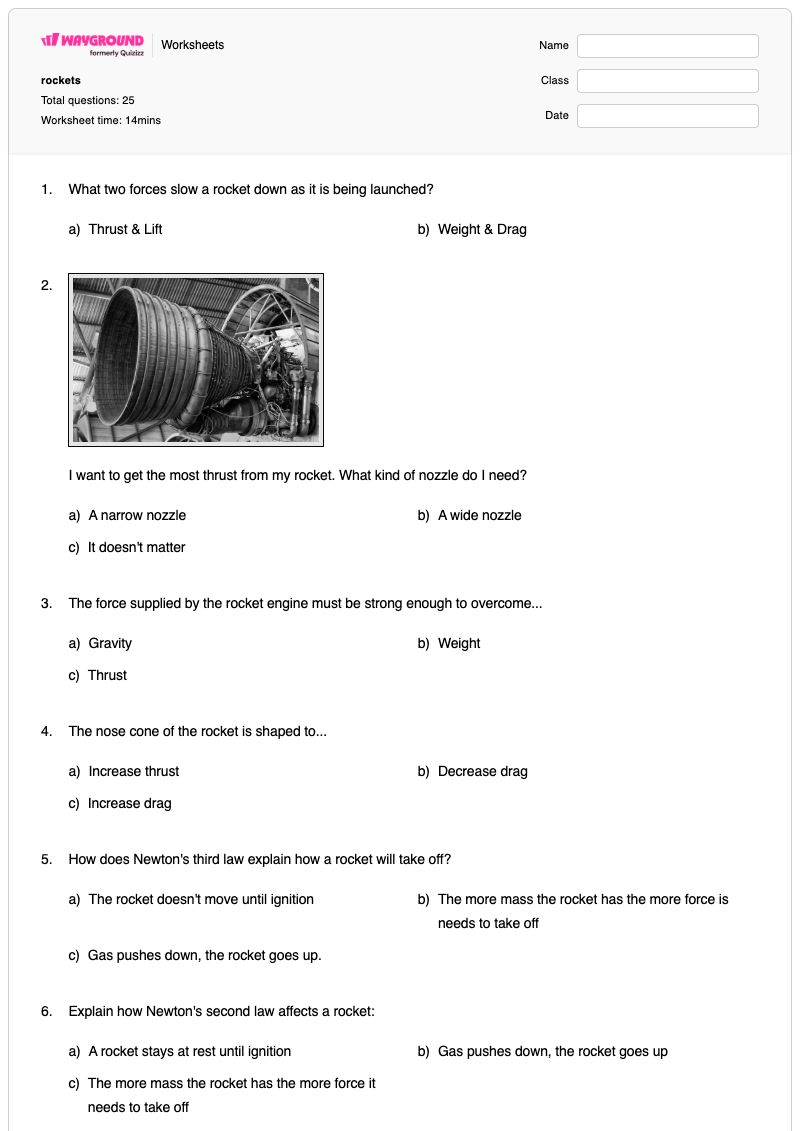
I want to get the most thrust from my rocket. What kind of nozzle do I need?

a)

A narrow nozzle

b)

A wide nozzle

c)

It doesn't matter

3.

The force supplied by the rocket engine must be strong enough to overcome...

a)

Gravity

b)

Weight

c)

Thrust

4.

The nose cone of the rocket is shaped to...

a)

Increase thrust

b)

Decrease drag

c)

Increase drag

5.

How does Newton's third law explain how a rocket will take off?

a)

The rocket doesn't move until ignition

b)

The more mass the rocket has the more force is needs to take off

c)

Gas pushes down, the rocket goes up.

6.

Explain how Newton's second law affects a rocket:

a)

A rocket stays at rest until ignition

b)

Gas pushes down, the rocket goes up

c)

The more mass the rocket has the more force it needs to take off

7.

When a rocket is sitting on a launch pad, what type of energy does it have?

a)

Potential

b)

Kinetic

c)

Gravity

8.

When a rocket is blasting off into space, what type of energy does it have?

a)

Potential

b)

Kinetic

c)

Gravity

9.

Why is it important to have fins on your rocket?

a)

They stabilize the rocket

b)

The reduce drag

c)

They evenly distributes the weight

10.

How does Newton's first law explain how a rocket will take off?

a)

The rocket stays at rest until ignition.

b)

The more mass a rocket has the more force is needed to take off.

c)

Gas pushes down, the rocket goes up.

11.

Which of the four forces on a rocket is affected by gravity?

a)

Weight

b)

Thrust

c)

Lift

d)

Drag

12.

What 2 forces does thrust have to overcome for the rocket to be able to take off?

a)

Weight

b)

Thrust

c)

Lift

d)

Drag

13.

As a rocket gets further away from Earth...

a)

the force of gravity gets stronger.

b)

the force of gravity gets weaker.

14.
__________ means a change in motion.
a)
Force
b)
Mass
c)
Acceleration
d)
Inertia
15.
The amount of thrust (force) produced by the rocket engines needs to be __________ than the force of gravity holding it down.
a)
Equal
b)
Greater
c)
Less
16.
Relating to Newton’s Third Law, action and reaction, what is the reaction when a rocket expels gas, smoke and flames from the nozzle end of the rocket engine?
a)
Nothing
b)
Propels in the opposite direction
c)
Creates a balanced force
d)
Creates friction
17.

Which rocket component provides stability?

a)

fin

b)

streamer

c)

nose cone

d)

shockcord

18.

What is the function of the engine?

a)

to hold the nose cone to the body tube

b)

provides thrust

c)

provides stability

d)

to hold the rocket straight

e)

increases drag

19.

Who was the first person to step on to the moon?

a)

Neil Armstrong

b)

Buzz Aldrin

c)

Peter Andre

d)

Jacques Chirac

20.

Which of these will change the center of gravity on a rocket?

a)

The placement of the weight

b)

The placement of the fins

c)

The size of the fins

d)

The amount of water in the rocket

21.
What is a PUSH or PULL of an object?
a)
Motion
b)
Force
c)
Friction
d)
Gravity
22.
Which force produces a change in motion?
a)
unbalanced force
b)
balanced force
c)
gravitational force
d)
frictional force
23.
It takes more force to accelerate the iron man on the left than the iron man on the right because the iron man on the left has more mass. This best describes
a)
Newton's first law, the law of inertia
b)
Newton's second law, the law of acceleration
c)
Newton's third law, the law of action reaction 
d)
The law of universal gravitation
24.
For every action, there is an equal and opposite reaction.
a)
Newton's
1st
Law of Motion
b)
Newton's
2nd
Law of Motion
c)
Newton's
3rd
Law of Motion
25.
An automobile you are riding in suddenly stops, but you continue to go forward.
a)
Newton's
1st
Law of Motion
b)
Newton's
2nd
Law of Motion
c)
Newton's
3rd
Law of Motion
Answer Key

rockets

Total questions: 25

1.
b)

Weight & Drag

2.
a)

A narrow nozzle

3.
b)

Weight

, a)

Gravity

4.
b)

Decrease drag

5.
c)

Gas pushes down, the rocket goes up.

6.
c)

The more mass the rocket has the more force it needs to take off

7.
a)

Potential

8.
b)

Kinetic

9.
a)

They stabilize the rocket

10.
a)

The rocket stays at rest until ignition.

11.
a)

Weight

12.
a)

Weight

, d)

Drag

13.
b)

the force of gravity gets weaker.

14.
c) Acceleration
15.
b) Greater
16.
b) Propels in the opposite direction
17.
a)

fin

18.
b)

provides thrust

19.
a)

Neil Armstrong

20.
a)

The placement of the weight

21.
b) Force
22.
a) unbalanced force
23.
b) Newton's second law, the law of acceleration
24.
c) Newton's
3rd
Law of Motion
25.
a) Newton's
1st
Law of Motion

FAQs

What does this rockets worksheet help Grade 7 students learn?

This worksheet asks students to apply forces and motion concepts to rocket launches through 23 multiple-choice questions and 2 multiple-select questions. Students identify the roles of thrust, weight, drag, and lift; connect Newton’s three laws to takeoff; distinguish potential and kinetic energy; and explain how features such as a narrow nozzle, nose cone, and fins affect a rocket.

How can I use this worksheet to teach forces and Newton’s laws with rockets?

Introduce the four forces named in the worksheet, then have students explain why thrust must overcome weight and drag before attempting the questions. After students work through the Newton’s law items, ask them to justify which law describes a rocket remaining at rest, gas pushing downward as the rocket rises, and greater force being needed for greater mass. Use the two multiple-select questions as discussion prompts because students must identify more than one force.

What mistakes should I watch for when students complete this rocket worksheet?

Students may confuse weight with gravity, or select thrust as a force that the engine must overcome instead of identifying weight and drag. They may also mix up Newton’s laws by assigning the gas-pushes-down explanation to the second law rather than the third law, or confuse potential energy on the launch pad with kinetic energy during liftoff. Check the two multiple-select items carefully because each requires two correct choices.

How do I assign and grade this rockets worksheet?

The worksheet is available as a printable PDF and as a digital quiz on Wayground, with a complete answer key for all 25 questions. You can grade printable submissions by scanning student work with the Wayground for Teachers app, or review responses through the digital quiz. The printable option can also support instruction in classrooms working to reduce screen time.

How can I differentiate this rocket forces worksheet for my students?

Use the worksheet’s Advanced Settings to adjust font spacing or increase the font size so the 23 multiple-choice and 2 multiple-select items are easier to read. You can also apply a dyslexia-friendly font or translate the worksheet into another language while keeping its rocket forces and Newton’s laws content intact.

Where can I find more free worksheets like this on Wayground?

Wayground offers a comprehensive collection of free printable worksheets and practice problems across subjects, with downloadable PDFs and answer keys to help students master essential skills and concepts. Browse more resources at https://wayground.com/en-us/worksheets.