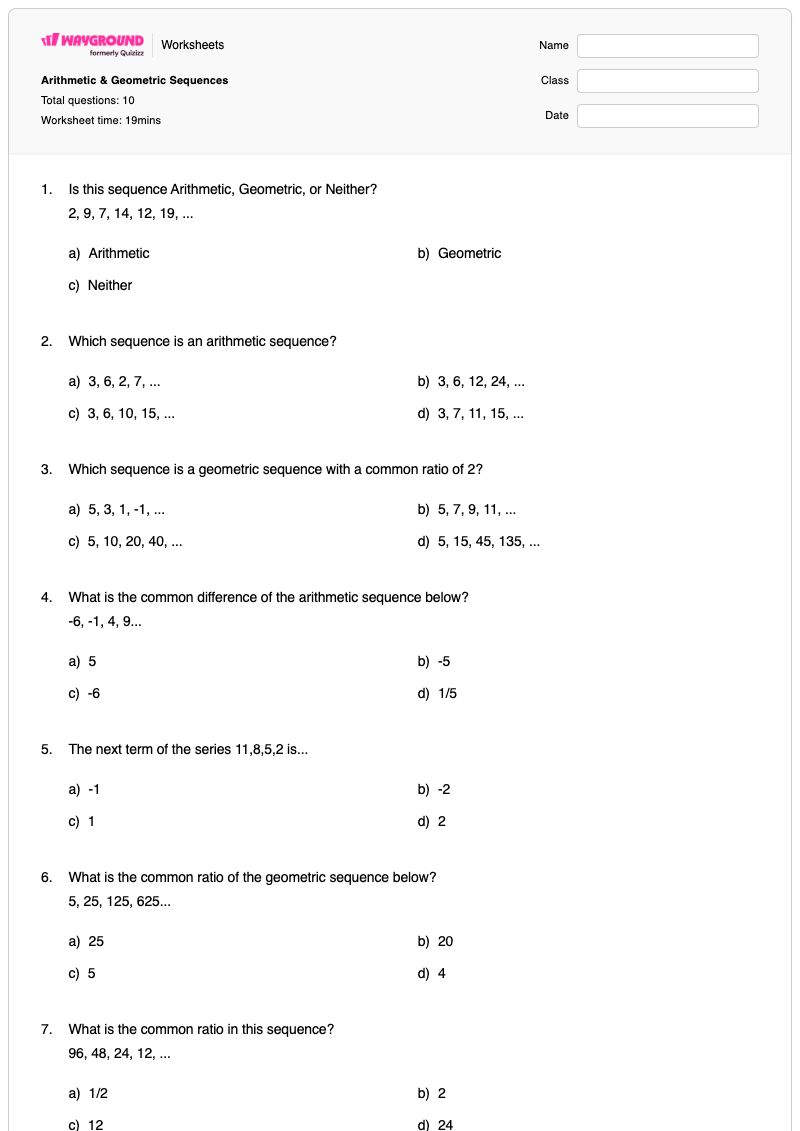
Arithmetic & Geometric Sequences is a Grade 9 mathematics worksheet that helps students classify sequences and identify the rule connecting their terms. Across 10 items—9 multiple-choice questions and 1 dropdown question—students distinguish arithmetic, geometric, and neither sequences; find common differences and ratios; determine missing next terms; and identify whether sequence graphs are linear or exponential.
The worksheet also applies sequence formulas to find the 28th term of an arithmetic sequence and the 7th term of a geometric sequence, including examples with negative values and fractional ratios. These varied questions build accuracy with both recursive patterns and explicit nth-term formulas while reinforcing the difference between additive and multiplicative change. This free printable worksheet includes a complete answer key for efficient checking, independent practice, or a focused Grade 9 sequence review.
Worksheet settings
Font size
S
M
L
XL
Worksheets
Arithmetic & Geometric Sequences
Total questions: 10
Name
Class
Date
1.
Is this sequence Arithmetic, Geometric, or Neither?
2, 9, 7, 14, 12, 19, ...
a)
Arithmetic
b)
Geometric
c)
Neither
2.
Which sequence is an arithmetic sequence?
a)
3, 6, 2, 7, ...
b)
3, 6, 12, 24, ...
c)
3, 6, 10, 15, ...
d)
3, 7, 11, 15, ...
3.
Which sequence is a geometric sequence with a common ratio of 2?
a)
5, 3, 1, -1, ...
b)
5, 7, 9, 11, ...
c)
5, 10, 20, 40, ...
d)
5, 15, 45, 135, ...
4.
What is the common difference of the arithmetic sequence below? -6, -1, 4, 9...
a)
5
b)
-5
c)
-6
d)
1/5
5.
The next term of the series 11,8,5,2 is...
a)
-1
b)
-2
c)
1
d)
2
6.
What is the common ratio of the geometric sequence below? 5, 25, 125, 625...
a)
25
b)
20
c)
5
d)
4
7.
What is the common ratio in this sequence?
96, 48, 24, 12, ...
a)
1/2
b)
2
c)
12
d)
24
8.
The first term in an arithmetic sequence is -8 and the common difference is 14. What is the 28th term given the equation an = a1 + d (n - 1)
a)
378
b)
1024
c)
-324
d)
370
9.
The first term in a geometric sequence is 160 and the common ratio is 1/2. What is the 7th term given the equation an = a1 (r)n-1
a)
5
b)
2.5
c)
10
d)
1.25
10.
The graph of an arithmetic sequence is (a) and the graph of a geometric sequence is (b) .
Choose from the below words
linear
exponential
Answer Key
Arithmetic & Geometric Sequences
Total questions: 10
1.
c)
Neither
2.
d)
3, 7, 11, 15, ...
3.
c)
5, 10, 20, 40, ...
4.
a)
5
5.
a)
-1
6.
c)
5
7.
a)
1/2
8.
d)
370
9.
b)
2.5
10.
linear, exponential
140 %
Browse by subjects
Browse by grades
Browse by format
FAQs
What does the Arithmetic & Geometric Sequences worksheet cover?
This Grade 9 worksheet uses 9 multiple-choice questions and 1 dropdown question to assess sequence classification, common differences, common ratios, next terms, nth-term calculations, and graph types. Students decide whether patterns are arithmetic, geometric, or neither, then apply the formulas for the 28th arithmetic term and 7th geometric term. The final item connects arithmetic sequences with linear graphs and geometric sequences with exponential graphs.
How can I use this worksheet to teach arithmetic and geometric sequences?
Introduce the worksheet by having students compare consecutive terms: ask whether each pattern changes by addition or subtraction, or by multiplication or division. Model one common-difference example and one common-ratio example before students complete the classification and identification items. Then use the nth-term questions to discuss why the formulas use n − 1, and have students explain how the sequence rules relate to linear and exponential graphs.
What mistakes should I watch for when students complete this sequence worksheet?
Students may classify a sequence by noticing a visual pattern without checking every consecutive pair, or confuse a common difference with a common ratio. Watch for sign and fraction errors, especially when finding the ratio of 96, 48, 24, 12 and when extending the decreasing sequence 11, 8, 5, 2. In the nth-term items, students may substitute n instead of n − 1 or use the arithmetic formula for a geometric sequence.
How do I assign and grade this Arithmetic & Geometric Sequences worksheet?
Wayground provides this sequence worksheet as a printable PDF and as a digital quiz, and it includes a complete answer key. Assign the digital version for online practice, or print the 10-item worksheet for paper-based work. Printable submissions can be graded by scanning student work with the Wayground for Teachers app.
How can I differentiate this worksheet for my students?
Use the worksheet’s Advanced Settings to adjust font spacing or increase the font size so the sequence terms, answer choices, and nth-term formulas are easier to read. You can also select a dyslexia-friendly font or translate the worksheet into another language when helpful. These changes apply to the worksheet file itself, including its multiple-choice and dropdown content.
Where can I find more worksheets like this on Wayground?
Wayground offers a comprehensive collection of free printable worksheets and practice problems across subjects, with downloadable PDFs and answer keys to support essential skill and concept mastery. Browse more resources at https://wayground.com/en-us/worksheets.

 Worksheets