
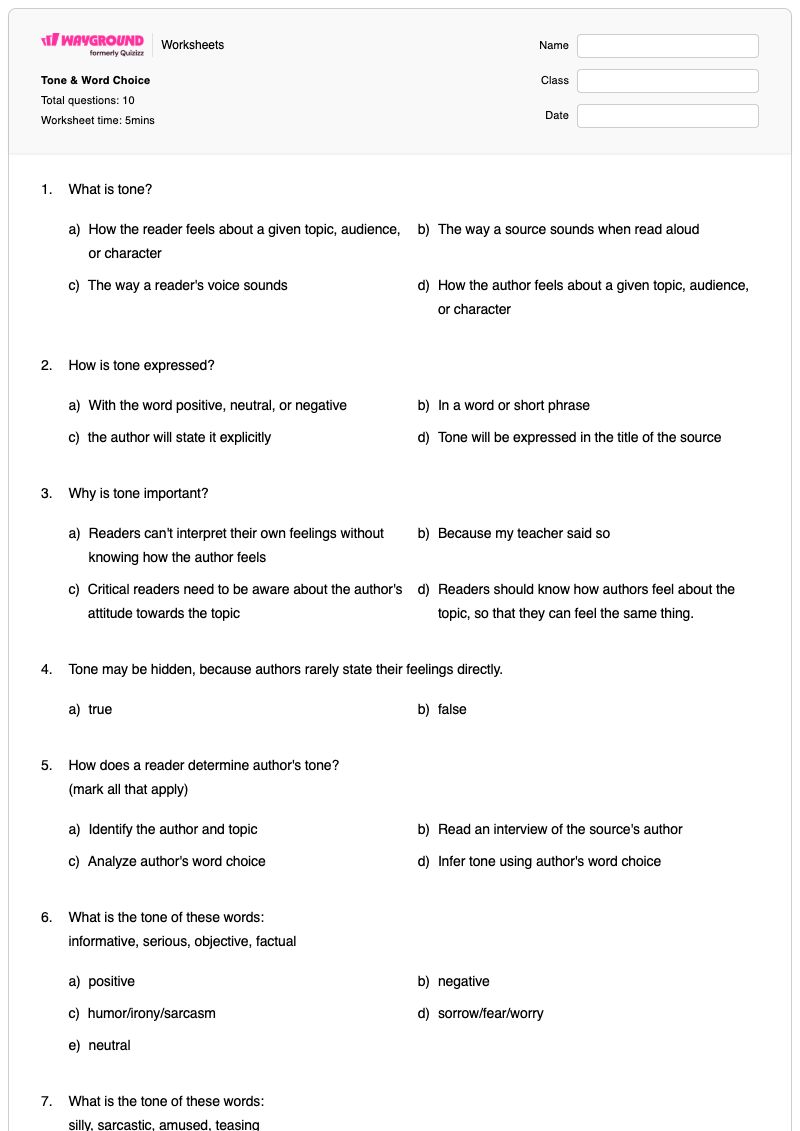

Tone & Word Choice is a free printable Grade 6 English worksheet with an answer key that helps students identify an author’s attitude toward a topic, audience, or character. Across 10 questions—9 multiple choice and 1 multiple-select—students define tone, recognize that it may be implied rather than stated directly, and explain how readers use the author’s identity, topic, and word choice to infer it.
Students then classify word groups as positive, negative, neutral, humor/irony/sarcasm, or sorrow/fear/worry. Examples such as “informative, serious, objective, factual” and “friendly, sweet, confident, loving” give learners practice connecting specific vocabulary to tone categories. This worksheet is useful for introducing tone, checking understanding after instruction, or reviewing how critical readers interpret an author’s attitude without confusing it with the reader’s feelings or the sound of a voice.
Worksheet settings
Font size
S
M
L
XL
Worksheets
Tone & Word Choice
Total questions: 10
Name
Class
Date
1.
What is tone?
a)
How the reader feels about a given topic, audience, or character
b)
The way a source sounds when read aloud
c)
The way a reader's voice sounds
d)
How the author feels about a given topic, audience, or character
2.
How is tone expressed?
a)
With the word positive, neutral, or negative
b)
In a word or short phrase
c)
the author will state it explicitly
d)
Tone will be expressed in the title of the source
3.
Why is tone important?
a)
Readers can't interpret their own feelings without knowing how the author feels
b)
Because my teacher said so
c)
Critical readers need to be aware about the author's attitude towards the topic
d)
Readers should know how authors feel about the topic, so that they can feel the same thing.
4.
Tone may be hidden, because authors rarely state their feelings directly.
a)
true
b)
false
5.
How does a reader determine author's tone?
(mark all that apply)
a)
Identify the author and topic
b)
Read an interview of the source's author
c)
Analyze author's word choice
d)
Infer tone using author's word choice
6.
What is the tone of these words:
informative, serious, objective, factual
a)
positive
b)
negative
c)
humor/irony/sarcasm
d)
sorrow/fear/worry
e)
neutral
7.
What is the tone of these words:
silly, sarcastic, amused, teasing
a)
positive
b)
negative
c)
humor/irony/sarcasm
d)
sorrow/fear/worry
e)
neutral
8.
What is the tone of these words:
nervous, upset, confused, anxious
a)
positive
b)
negative
c)
humor/irony/sarcasm
d)
sorrow/fear/worry
e)
neutral
9.
What is the tone of these words:
cold, boring, tired, snooty
a)
positive
b)
negative
c)
humor/irony/sarcasm
d)
sorrow/fear/worry
e)
neutral
10.
What is the tone of these words:
friendly, sweet, confident, loving
a)
positive
b)
negative
c)
humor/irony/sarcasm
d)
sorrow/fear/worry
e)
neutral
Answer Key
Tone & Word Choice
Total questions: 10
1.
d)
How the author feels about a given topic, audience, or character
2.
b)
In a word or short phrase
3.
c)
Critical readers need to be aware about the author's attitude towards the topic
4.
a)
true
5.
a)
Identify the author and topic
, c)
Analyze author's word choice
, d)
Infer tone using author's word choice
6.
e)
neutral
7.
c)
humor/irony/sarcasm
8.
d)
sorrow/fear/worry
9.
b)
negative
10.
a)
positive
140 %
Browse by subjects
Browse by grades
Browse by format
FAQs
What does the Tone & Word Choice worksheet cover?
This Grade 6 worksheet teaches students to distinguish an author’s tone from the reader’s feelings or the sound of a voice. Its 10 questions ask students to define tone, explain how it is expressed, select the steps used to infer it, and classify word groups as positive, negative, neutral, humor/irony/sarcasm, or sorrow/fear/worry.
How can I use this worksheet to teach students to identify tone?
Introduce tone as the author’s attitude toward a topic, audience, or character, then model how word choice can reveal an attitude that is not stated directly. Before students complete the multiple-choice and multiple-select items, compare a few word groups from the worksheet—such as “informative, serious, objective, factual” and “silly, sarcastic, amused, teasing”—and ask which tone category each group suggests and why.
What mistakes should I watch for when students complete this tone worksheet?
Students may confuse tone with how the reader feels, how a voice sounds, or an emotion that the author states explicitly. In the multiple-select question, watch for students who choose only “analyze author’s word choice” but miss identifying the author and topic or inferring tone from those words; in the classification items, they may also confuse neutral vocabulary with positive or negative language.
How do I assign and grade the Tone & Word Choice worksheet?
You can assign this worksheet as a printable PDF or as a digital quiz on Wayground. It includes a complete answer key, and printable submissions can be graded by scanning student work with the Wayground for Teachers app. The printable format also gives schools an option for reducing screen time while students practice tone and word choice.
How can I differentiate this Tone & Word Choice worksheet for my students?
Use the worksheet’s Advanced Settings to adjust font spacing or font size so the tone definitions, multiple-choice options, and word-group examples are easier to read. You can also apply a dyslexia-friendly font or translate the worksheet into another language, depending on your students’ needs.
Where can I find more free worksheets like this on Wayground?
Wayground offers a broad collection of free printable worksheets and practice problems across subjects, with downloadable PDFs and answer keys to support essential skills and concepts. Browse more resources at https://wayground.com/en-us/worksheets.